Prekmurska Gibanica: Slovenia’s Protected Layered Pastry, Explained
by Darja · Published Aug 18, 2026 · Updated Sep 10, 2026 · 5 min read
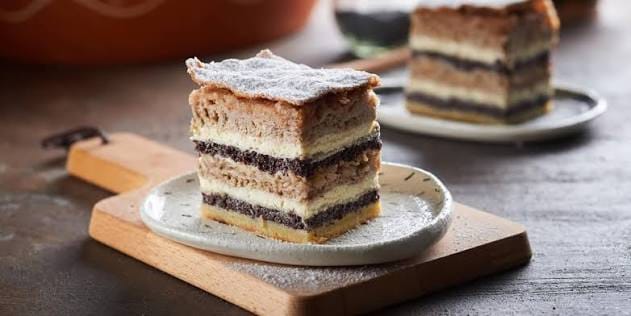
Quick answer: Prekmurska gibanica is a layered pastry from Slovenia’s Prekmurje region, made of four fillings — poppy seed, walnut, apple and cottage cheese — stacked between sheets of dough with a sour cream custard, then baked and served cold. It has been protected at EU level as a Traditional Speciality Guaranteed since March 2010.
Most Slovenian desserts do not travel far from their home region, but prekmurska gibanica is the exception that proves the point — a pastry so specific to one corner of the country that the European Union protects the recipe by name.
It is one of the country’s traditional Slovenian dishes worth planning a detour for. It comes from Prekmurje, a flat agricultural region in Slovenia’s far north-east, tucked between Austria, Hungary and Croatia. The dish reflects that position: Hungarian pastry technique, Austrian dairy tradition, and a Slavic habit of stretching an ordinary Sunday cake into an occasion. What results is a dense, four-layered square that takes real patience to make and even more to eat slowly.
What Exactly Is Gibanica?
“Gibanica” traces back to güba, the Prekmurje dialect word for a fold — a reference to the layering, not the finished texture. Several regions of Slovenia and the wider Balkans have their own gibanica, usually a simpler cheese-and-filo bake. Prekmurska gibanica, the version from Prekmurje, is the most elaborate: four distinct fillings rather than one, and a soured-cream custard poured between every layer to bind it.
The result sits somewhere between a cake and a strudel — sliceable like a torte, but built layer by layer like baklava.
Where It Comes From
Prekmurje was part of the Kingdom of Hungary until 1919, and the region’s food still shows it — paprika, poppy seed pastries, and rich dairy fillings all point to Hungarian and Austro-Hungarian roots rather than the Alpine or Mediterranean influences found elsewhere in Slovenia.
The earliest documented mention appears in 1828, in a description by the Prekmurje priest Jožef Kosič, who recorded it as a wedding pastry served at gostüvanje feasts. Even then it was built from what a farm had at once: poppy seeds and walnuts from the autumn harvest, apples from the orchard, and fresh cottage cheese from the dairy.
Protection came in two steps. Slovenia granted it national protection in 2004. On 1 March 2010 the European Commission entered the name in the EU register of traditional specialities guaranteed, making it only the second Slovenian food to earn TSG status after idrijski žlikrofi. TSG protects the recipe and the method rather than the geography — anyone may bake it anywhere, but only a version that follows the registered specification may carry the name.
It is worth contrasting with Slovenia’s other famous pastry. The Bled cream cake is protected the opposite way round: its name is a registered trademark rather than its recipe, so anyone may bake a cream slice but only one kitchen in Bled may call theirs the original.
What’s In It
| Layer | Filling | Flavour note |
|---|---|---|
| 1st | Ground poppy seed, sweetened | Earthy, slightly bitter |
| 2nd | Cottage cheese (skuta) | Tangy, creamy |
| 3rd | Grated apple with cinnamon | Bright, lightly spiced |
| 4th | Ground walnut, sweetened | Rich, nutty |
Every layer sits between sheets of dough — traditionally a shortcrust base with pulled filo above — and gets its own pour of custard made from sour cream, eggs and sugar. That custard is what makes the dish work: without it the layers would dry and separate; with it, they bake into something closer to a set, sliceable cake.
Prekmurska Gibanica Recipe
This is the traditional four-filling version, scaled for a standard deep baking tray of roughly 30 by 40 cm. It makes 12 generous squares.
- Prep time1 hr 30 min
- Bake time50-60 min
- Rest time3 hrs (best overnight)
- Yield12 servings
Ingredients
- 500 g shortcrust pastry, thinly rolled
- 500 g strudel or filo dough, layered
- 300 g poppy seeds, ground
- 300 g walnuts, ground
- 500 g apples, grated
- 500 g cottage cheese (skuta)
- 6 eggs
- 400 ml sour cream
- 200 g sugar
- 150 g butter, melted
- 1 tsp cinnamon
Method
- Prepare the four fillings separately: sweetened ground poppy seed, sweetened ground walnut, grated apple with cinnamon, and cottage cheese mixed with 2 eggs.
- Whisk the remaining eggs with the sour cream and sugar to make the custard that goes between every layer.
- Line a deep baking tray with the shortcrust pastry, brush with butter and custard, then add the poppy seed filling.
- Repeat with strudel dough and custard between each filling layer, in this order: poppy seed, cottage cheese, apple, walnut.
- Finish with a top layer of dough, brush generously with the remaining custard and butter.
- Bake at 180°C (355°F) for 50–60 minutes until deep golden brown. Cool fully before slicing — at least 3 hours, ideally overnight.
Want to taste it before you bake it?
Prekmurje bakeries make it fresh daily — see where to stop on a Slovenia road trip.
Where to Try It in Slovenia
Prekmurska gibanica is sold across Slovenia now, but the versions made in Prekmurje itself — particularly around Murska Sobota — are the ones made to the registered specification. Bakeries and gostilne in the region often sell it by the slice, and it is a standard offering at weddings and family celebrations throughout the area.
Outside Prekmurje, quality varies. Supermarket versions frequently cut a filling or thin the custard to speed up production, which is worth checking before you order if you want the real thing.
Frequently Asked Questions
What is prekmurska gibanica made of?
Four fillings – ground poppy seed, cottage cheese, grated apple and ground walnut – layered between sheets of pastry with a sour cream custard poured between every layer.
Is prekmurska gibanica UNESCO-listed?
No. It is listed in Slovenia’s national register of intangible cultural heritage, and separately protected by the European Union as a Traditional Speciality Guaranteed since 2010. The two are often confused.
Is prekmurska gibanica served warm or cold?
Cold. It needs at least three hours to set after baking, and it slices best the following day.
Where can I try authentic prekmurska gibanica in Slovenia?
In Prekmurje itself, particularly around Murska Sobota, where bakeries and gostilne follow the registered recipe. Elsewhere the quality varies.
How long does prekmurska gibanica keep?
Three to four days refrigerated. The custard keeps the layers moist, so it does not dry out as fast as a strudel.
More Slovenian food worth ordering: read about the Bled cream cake, or potica, Slovenia’s other EU-protected cake. Browse every guide in Slovenian traditional dishes. Eating out generally? Our guide to tipping in Slovenia covers what is (and is not) expected at the table, or start planning the wider trip at Tips in Slovenia.

Darja
Writes destination guides for Tips in Slovenia, covering the country's cities, hidden gems and day trips.
Related guides
 Slovenian Traditional Dishes · 10 Sep 2026Potica: Slovenia’s Rolled Holiday Cake, ExplainedSlovenia's rolled holiday cake, EU-protected since 2021: what's really in it, the walnut-vs-tarragon debate, and how to make…
 Slovenian Traditional Dishes · 19 Aug 2026Bled Cream Cake (Kremšnita): The Story Behind Slovenia’s Most Famous DessertSlovenia's most famous dessert: who invented it in 1953, what the four layers are, and where to eat…
Newsletter
Don't miss anything new
One new Slovenia guide in your inbox every couple of weeks. No spam, unsubscribe any time.