Izola Travel Guide: Slovenia’s Fishing Harbour Town
by Darja · Published Sep 13, 2026 · 6 min read
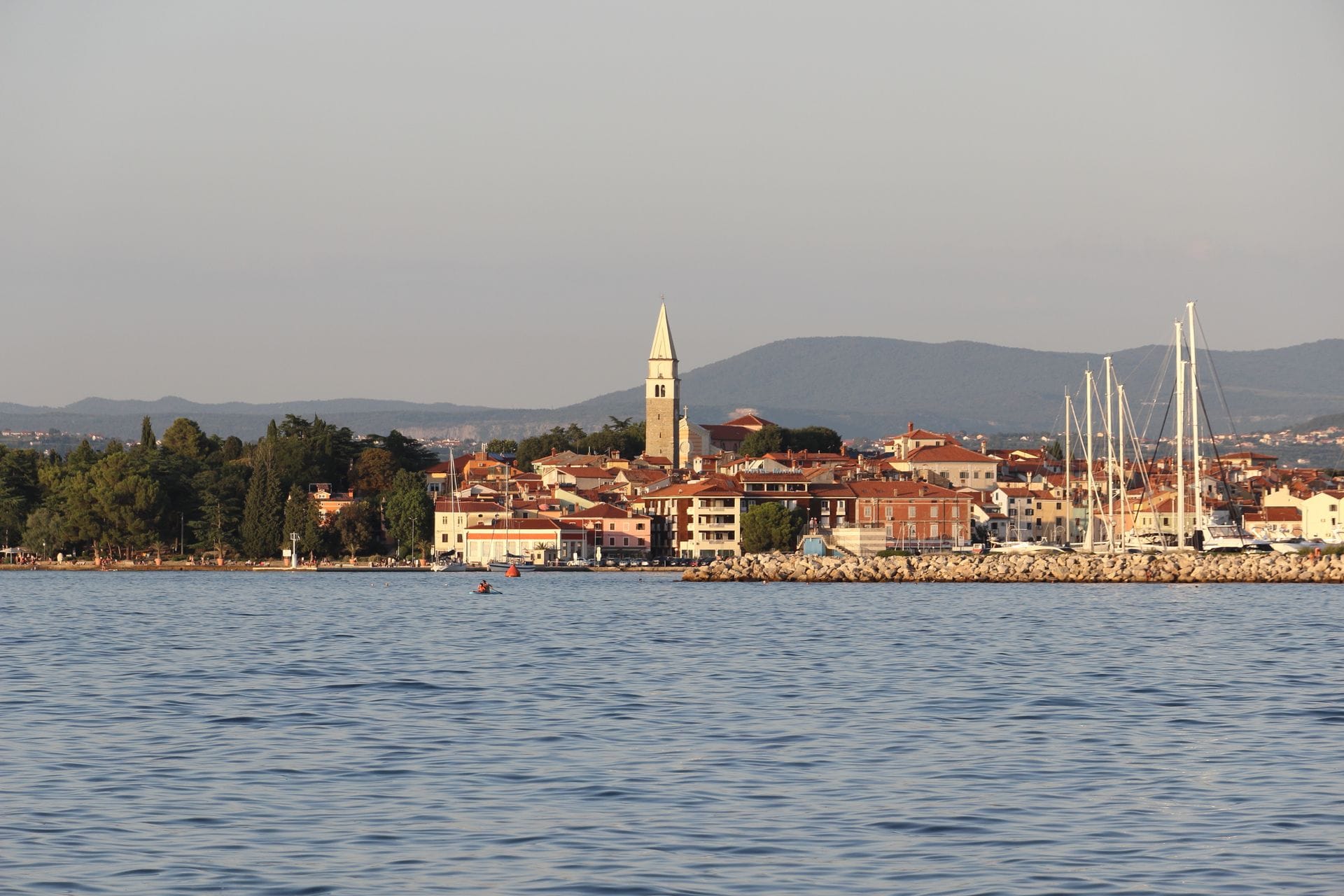
- PopulationAbout 11,500
- Under Venice1267 to 1797, five centuries under the Republic
- Known forThe mandrač fishing harbour, olive oil and the old Delamaris cannery
- How many days?1, easily paired with Piran or Koper
- Best months to visitMay-June and September, to avoid August
- From Ljubljana~110 km, about 1 hr 20 min
Izola was, quite literally, an island until the early 1800s. The name comes from the Italian isola, and the causeway that now carries traffic into the old town used to be open water.
Fishing and canning built the town from the Middle Ages onward, and it looked west toward Venice for five centuries: Izola became Venetian territory in 1267 and stayed that way until the Republic fell in 1797. The pastel houses stacked around the mandrač harbour and the pockets of Venetian Gothic in the old town are what that period left behind.
It is one of the guides in our section on Slovenian cities, and sits on the Slovenian coast, a few minutes up the road from Piran.
A Brief History of Izola
The settlement is first recorded as Insula in a Venetian document, the Liber albus, in 932 — Latin for “island,” which is exactly what it was: a small islet off the Istrian shore, reachable only by boat. It became definitively Venetian territory in 1267, and for the next five centuries its fortunes moved with the Republic’s.
Venice fell in 1797 and the coast passed first to Austria, then briefly to Napoleon’s Illyrian Provinces. It was during this Napoleonic period, in the early 1800s, that Izola’s town walls were pulled down and the stone used to fill in the channel separating the island from the mainland — the town has been physically attached to the coast ever since, even though the name never changed.
The 19th and 20th centuries turned Izola into an industrial fishing town. A cannery founded on the waterfront in 1881 grew into Delamaris, which by the early 1900s was supplying the Austro-Hungarian imperial army and exporting canned fish across Europe. Italian rule, German occupation and Yugoslav Slovenia followed in turn through the 20th century; the cannery outlasted all of them, only leaving Izola for a new factory inland in 2014.
Top Attractions
St Mauro’s Church and Bell Tower
The church at the top of the old town dates to 1356, though the bell tower beside it was added in 1585 and is the taller landmark by far — over 30 metres, with 99 steps to a viewing gallery that takes in the harbour, the rooftops and, on a clear day, Italy across the gulf. Inside are ten altars and an eighteenth-century organ.
The Mandrač
Izola’s old fishing harbour, tucked behind the church, is the postcard image of the town: painted houses, moored fishing boats and turquoise water in a tight horseshoe. It is a genuinely working harbour, not a recreation, and the boats still go out.
Manzioli Square and Palace
One of the oldest buildings in the old town stands on the square that shares its name. It is a quiet corner a few steps back from the harbour, the kind of place locals pass through more than tourists do.
Besenghi degli Ughi Palace
Built in an unusually short six years, from 1775 to 1781, by the Milanese architect Filippo Dongetti for the Besenghi family, this is one of the best-preserved Late Baroque palaces in Slovenia. A thirteenth-century stone lion sits at one corner, left over from an older building on the site. It now houses the town’s music school, with a historic library of some 3,000 books not generally open to visitors.
Izola Hidden Gems
Ljubljana Street
Locally nicknamed the artists’ street, this narrow lane just off the centre is lined with small studios and galleries rather than souvenir shops. It rewards a slow walk more than a guidebook stop.
Lonka Square Flea Market
On the second Saturday of every month, Lonka Square and the neighbouring park fill with a flea market of antiques, books and bric-a-brac. Worth timing a visit around if the dates line up.
The Šalet Tunnel and the Parenzana Trail
A 214-metre tunnel just south of town, built for the Parenzana railway that ran between 1902 and 1935, now carries walkers and cyclists on the route toward Strunjan. It is lit but unmistakably a former railway tunnel — cool, straight, and very different from the seafront above it.
Day Trips
| Destination | Distance | Drive time | Best for |
|---|---|---|---|
| Piran | ~8 km | ~12 min | Venetian old town, closed to cars |
| Koper | ~8 km | ~12 min | The coast’s largest town and working port |
| Portorož | ~10 km | ~15 min | Beaches, spa hotels and a promenade |
| Strunjan | ~5 km | ~10 min | Sea cliffs, salt pans and a nature reserve |
Piran (8 km)
Slovenia’s best-preserved Venetian old town is barely ten minutes down the coast, and it is closed to cars entirely — park at the edge and walk in. Read the full Piran travel guide before you go; between the two towns you can cover most of what the Slovenian coast has to offer in a long weekend.
Strunjan (5 km)
The closest thing to a wild landscape on this stretch of coast: cliffs up to 80 metres above the sea, a crescent-shaped bay known as Moon Bay, and salt pans still in use. Reachable on foot or bike through the Šalet Tunnel and the old Parenzana railway line.
Getting Around
Park at the edge of the old town, not in it. Izola’s centre is a tangle of narrow streets built for foot traffic, not cars, and space inside is limited and metered in summer. Free and cheaper paid lots ring the old town within a five-to-ten-minute walk of the harbour.
A small tourist train runs in the summer season, looping between the main parking areas and the town centre, useful if you are carrying beach gear or travelling with children.
Buses connect Izola with Koper, Piran and Portorož along the coast, and with Ljubljana inland. There is no railway station — the old Parenzana line closed in 1935 and is a cycling and walking trail today, not a working railway.
Izola Travel Guide – Tips
Come outside August. Izola is smaller and less visited than Piran, but the harbour and the beaches still fill up in high summer. May, June and September give you the same sea with more room.
Climb the bell tower for the view, not the church for the art. St Mauro’s tower is the single best vantage point in town, and it is far less crowded than the equivalent climbs in Piran.
Base yourself here if you want quiet. Izola has fewer hotels and a slower pace than Piran or Portorož, and everything on the coast is still within a twenty-minute drive.
FAQ
Is Izola worth visiting?
Yes, particularly as a quieter base than Piran or Portorož. It has a genuine working harbour, a compact old town, and none of the queues that build up around Piran’s bell tower in summer.
Is Izola or Piran better?
They are different, not competing. Piran has the grander Venetian architecture and is entirely closed to cars; Izola is smaller, quieter and still a working fishing town. Many visitors base themselves in one and day-trip to the other, which takes about ten minutes.
How many days do you need in Izola?
One day covers the old town comfortably. It pairs naturally with Piran or Koper, both under fifteen minutes away, for a longer coastal stop.
Was Izola really an island?
Yes. The name comes from the Italian isola, island, and the old town was physically separated from the mainland by a channel until the early 1800s, when it was filled in and the walls that once ringed the island were dismantled to do it.
How do I get from Ljubljana to Izola?
About 110 km, roughly an hour and twenty minutes by car, or by bus via Koper. There is no train to Izola.
Read the guide to Piran, the Venetian old town just up the coast. More on Slovenia’s cities: read the guides to Ljubljana, Maribor, Celje and Ptuj, see the whole Slovenian coast, or start planning the wider trip at Tips in Slovenia.

Darja
Writes destination guides for Tips in Slovenia, covering the country's cities, hidden gems and day trips.
Related guides
 Slovenia Travel Tips · 6 Sep 2026Luka Dončić’s Ljubljana: A Guide to His Hometown for Lakers FansThis isn’t a Luka Dončić biography — it’s a practical guide to visiting his hometown of Ljubljana if…
 Slovenian Cities · 28 Aug 2026Bled Travel Guide: The Island, the Castle and What It CostsSlovenia's most photographed lake: what it actually costs, when to come, and what is worth doing rather than…Slovenian Cities · 27 Aug 2026Piran Travel Guide: Slovenia’s Venetian Old TownFive centuries of Venice on a peninsula under a square kilometre: what to see, when to come, and…
Newsletter
Don't miss anything new
One new Slovenia guide in your inbox every couple of weeks. No spam, unsubscribe any time.