Kranjska Gora Travel Guide: Skiing, Hiking and the Vršič Pass
by Darja · Published Oct 16, 2026 · Updated Oct 30, 2026 · 10 min read
- PopulationAbout 1,490 in the town itself (2025)
- Elevation806 m, one of the higher towns in Slovenia
- Known forAlpine ski racing, the Vršič Pass and the world’s largest ski flying hill at Planica
- How many days?1-2 days, more if you’re skiing or using it as a hiking base
- Best months to visitDecember-March for skiing, June-September for hiking and the pass
- From Ljubljana~85 km, about 1h15 by car
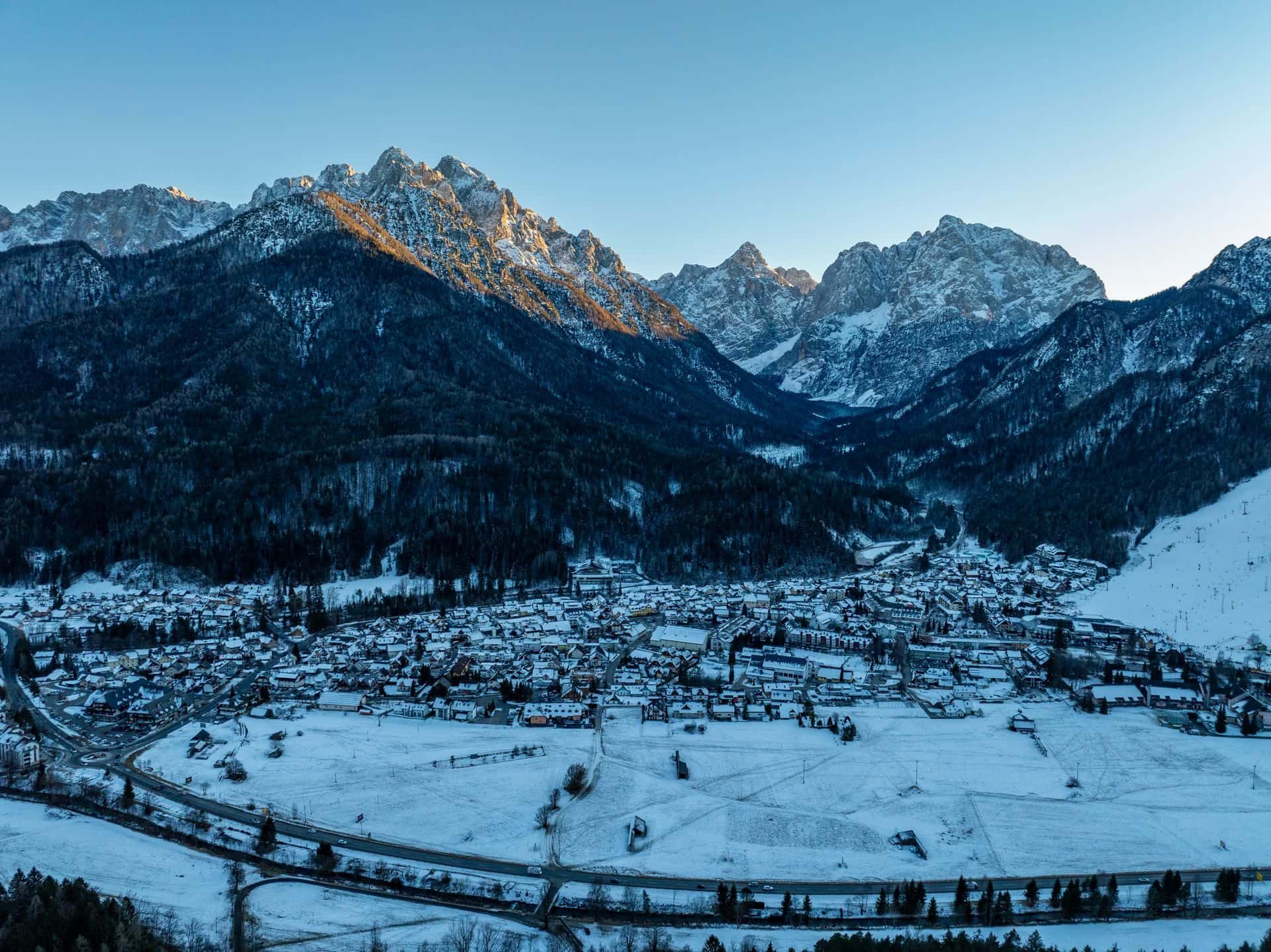
Kranjska Gora is Slovenia’s best-known ski town, tucked into the far northwestern corner of the country where the Julian Alps meet the Austrian and Italian borders. Every winter it hosts a men’s World Cup alpine ski race on a course regulars rank alongside Adelboden and Alta Badia, and every summer the same valley turns into one of the country’s main hiking bases, with the Vršič Pass – Slovenia’s highest – climbing straight out of town toward Triglav National Park.
The town itself is small and low-key, built more for getting people onto the mountain than for lingering in a historic centre. What draws visitors is almost entirely outdoors: the Vitranc ski area, the ski flying hill at nearby Planica, waterfalls and alpine lakes within a short drive, and some of the classic trailheads into the Julian Alps.
It is one of the guides in our section on Slovenian cities, and sits right at the edge of the Slovenian mountains, a short drive from Lake Jasna and the start of the routes up Triglav.
A Brief History of Kranjska Gora
The area was likely first settled in the 11th century by Slovenes from Carantania, and the town is first mentioned in writing in 1326, under an early form of its name – it was also once known as Borovska vas. In the 12th century it was a fief of the Counts of Ortenburg, and by the 14th century it lay on a trade route toward Tarvisio, across the border in what is now Italy. The Counts of Celje built a castle here in 1431, and the settlement came under Ottoman attack in 1476, part of the same wave of raids that reached much of inland Slovenia in that period.
A railway connection in 1870 opened the valley up, but it was the First World War that left the deepest mark. In 1915, the Austro-Hungarian military built a road over the Vršič Pass to keep supplies moving to the Isonzo Front, using somewhere between 10,000 and 12,000 Russian prisoners of war as forced labour. An avalanche on the pass in March 1916 killed 106 prisoners and 18 guards; the same prisoners had already built a small wooden chapel just off the road to honour earlier losses, and it still stands today, restored in 2005 and again in 2010. Locals still call the road itself the Ruska cesta, the Russian Road.
Tourism took over after the Second World War. Ski lifts went up on Vitranc between 1948 and 1965, and Kranjska Gora became Slovenia’s first proper ski resort. It has hosted a men’s World Cup alpine race every year since 1961, and the nearby Planica valley grew from a single ski jump into one of the largest ski flying complexes in the world. Today the town runs almost entirely on that two-season rhythm – skiing in winter, hiking and mountain driving in summer.
Top Attractions
The Vitranc World Cup Course
Kranjska Gora has hosted a men’s FIS Alpine Ski World Cup race every year since 1961, missing only a handful of editions to weather or administrative mishaps – it’s considered one of the three most prestigious giant slalom venues in the world, alongside Adelboden and Alta Badia. Since 1983 the races run on the Podkoren 3 course, the steepest groomed run in Slovenia at a 30.5-degree maximum incline. In 1982, Bojan Križaj became the first Slovenian to win at home, in front of roughly 32,000 spectators – still an attendance record for Slovenian alpine skiing.
Liznjek House
An 18th- and 19th-century farmhouse in the old centre of town, opened as an ethnological museum after a 1983 restoration. It was once the wealthiest homestead in the area, with 84 hectares of land, and its rooms are furnished to show how a well-off peasant family lived in the mid-1800s. The basement also holds a small exhibition on Josip Vandot, the local writer who created the folk character Kekec.
Church of the Assumption of Mary
A late Gothic parish church with Carinthian rib vaulting, holding 15th-century sculptures and paintings by Leopold Layer. It’s a quieter, less-visited stop than the ski venues, but it’s the clearest trace of the town’s life before tourism took over.
The Russian Chapel
A small Russian Orthodox chapel on the Vršič road, built in 1915 by the same prisoners of war who built the pass road itself, to honour comrades killed in an avalanche the following winter. It’s a short stop on the way up to the pass, and one of the few places in Slovenia that marks this specific piece of First World War history.
Skiing in Kranjska Gora
Kranjska Gora opened as Slovenia’s first ski resort in 1948, and the Vitranc ski area still centres the town’s winter season. There’s around 20 km of groomed runs across 19 named trails – a mix of 2 expert, 5 advanced, 8 intermediate and 2 beginner slopes – running between about 811 m and 1,295 m, with snowmaking to cover thin years. See our guide to skiing in Slovenia for how Vitranc compares to the country’s other resorts.
The resort’s reputation rests mostly on ski racing: it has hosted a men’s World Cup slalom and giant slalom every season since 1961, on the Podkoren 3 course since 1983, and is a member of Club5+, an informal group of the sport’s classic venues. If you’re not racing, the same course is open to the public outside competition days, and it’s as steep as the pros make it look.
Cross-country skiers have about 40 km of tracks around the valley floor. A short drive away in the Tamar Valley, Planica is worth a visit even if you don’t ski – the Letalnica bratov Gorišek is the largest hill in its ski flying complex, built in 1969 and the site of 29 world records since, including the first jump ever to clear 200 metres, in 1994. The complex has hosted the FIS Ski Flying World Championships seven times and stays open through summer, with a museum, a steep zip line and the Red Bull 400 uphill sprint race held there each September.
Hiking from Kranjska Gora
The Vršič Pass is the obvious starting point – at 1,611 m it’s Slovenia’s highest paved mountain pass, reached by a road of 50 numbered hairpin bends that the Russian POWs built in 1915. It closes with the first heavy snow and doesn’t reopen until the road is clear, so treat it as a summer and early-autumn route. From the top, trailheads lead to Prisojnik (2,547 m), and to Mala Mojstrovka (2,332 m) and Velika Mojstrovka (2,366 m), with mountain lodges – Erjavec, Tičar and the Poštarski dom – spaced along the way for those not doing it all in one push.
For something less committing, the Martuljek waterfalls start from a car park in Gozd Martuljek, about 5 km from Kranjska Gora. It’s a moderate out-and-back of roughly 7.9 km and 3 hours 15 minutes, with a short cabled section near the top – the upper falls drop about 110 m in three stages through a narrow gorge, and a small mountain hut, Pri Ingotu, serves food in season.
Serious hikers use Kranjska Gora as a base for Mojstrana and the Vrata Valley, the classic northern approach to Triglav. Aljažev dom, the mountain lodge at the head of the valley, sits about 12 km and roughly 2.5 hours on foot from Mojstrana – see our guide to climbing Triglav for the routes and difficulty from there. Mojstrana and nearby Gozd Martuljek are also the trailheads for several of the routes in our via ferrata guide.
Kranjska Gora Hidden Gems
Zelenci Nature Reserve
A short walk from town, Zelenci is the spring that feeds the Sava Dolinka river, named for the intense green of its water. It’s been a protected nature reserve since 1992, with boardwalks and a viewing tower built to keep visitors off the fragile ground around the spring itself – worth the detour even on a day built around skiing or driving the pass.
Day Trips
| Destination | Distance | Drive time | Best for |
|---|---|---|---|
| Vršič Pass | ~15 km | ~25 min | Scenic drive, hairpin bends, high-altitude hiking |
| Planica | ~5 km | ~10 min | Ski flying hill and museum |
| Lake Jasna | ~2 km | ~5 min | Photo stop right below the pass |
| Mojstrana & Vrata Valley | ~10 km | ~15 min | Alpine museum, gateway to Triglav’s north side |
Lake Jasna (2 km)
The small twin lake right below the start of the Vršič climb is one of the most photographed spots in the valley – see the full Lake Jasna guide for what to expect and how long to spend there.
Mojstrana (10 km)
A quieter village than Kranjska Gora, worth the drive for the Slovenian Alpine Museum, opened in 2010 and dedicated to the history of Slovenian mountaineering – and as the jumping-off point for Vrata Valley and Aljažev dom, the classic start for climbing Triglav from the north.
Getting Around
A car is genuinely useful here. Planica, Lake Jasna, the Martuljek trailhead and Mojstrana are all a short drive apart but spread out enough that walking between them isn’t realistic, and buses along the valley don’t run often enough for a flexible day.
Inside town itself, everything – Vitranc’s base stations, Liznjek House, the main square – is within easy walking distance. Parking fills up fast on winter weekends and during the World Cup race, so arrive early or expect to park further out and walk in.
Buses connect Kranjska Gora with Jesenice and on to Ljubljana, and with Bled and the rest of Gorenjska, but they’re infrequent enough that a car is the practical choice if you’re planning to see the pass, Planica and the lakes in the same trip.
Kranjska Gora Travel Guide – Tips
Pick your season on purpose. Kranjska Gora is really two different destinations – a ski town from December to March, and a hiking and driving base the rest of the year. Some lifts and mountain huts close entirely between the two seasons, so check before you plan around them.
Don’t rely on the Vršič Pass as a winter shortcut. It’s a spectacular summer drive but closes with the first serious snowfall and stays closed for months – check conditions before you build a route around it outside June to September.
Book World Cup weekend accommodation early. The annual Vitranc Cup race fills the town’s hotels well in advance, and parking and traffic get noticeably tighter on race days.
More Ways to Experience Kranjska Gora
Partner content — the widget below is provided by Viator, one of our booking partners. Browsing or booking through it supports Tips in Slovenia at no extra cost to you.
FAQ
Is Kranjska Gora worth visiting?
Yes, especially if you ski or hike. It’s Slovenia’s main alpine ski town in winter and a solid hiking base in summer, with the Vršič Pass, Planica’s ski flying hill and several lakes and waterfalls within a short drive. It’s less of a draw if you’re after historic architecture or a classic old town.
Kranjska Gora or Bled – which is better?
They serve different trips. Bled has the lake, the island and the castle, and works well as a base for sightseeing with minimal driving. Kranjska Gora is built around skiing and hiking rather than sightseeing, and sits closer to the Vršič Pass and the Julian Alps. Many visitors combine both on the same trip.
How many days do you need in Kranjska Gora?
A day or two covers the town, Planica and Lake Jasna. Add more if you’re skiing, driving the Vršič Pass, or using it as a base for longer hikes toward Triglav – three to four days gives you room to do all of it without rushing.
Is the Vršič Pass open in winter?
Not reliably. The road closes with the first heavy snowfall and typically doesn’t reopen until late spring, once it’s been cleared. Plan to drive it between June and September, and always check current conditions before setting out in shoulder-season months.
How do I get from Ljubljana to Kranjska Gora?
About 85 km, roughly an hour and a quarter by car on the highway via Kranj and Jesenice. There’s also a bus connection, though it takes longer and runs less frequently than the drive.
Read the guide to Lake Jasna, right below the pass, or climbing Triglav from the Vrata Valley nearby. For more of the Julian Alps, see Velika Planina and the Soča River, or stay closer with Lake Bohinj and Bled. See the whole Slovenian mountains section, or start planning the wider trip at Tips in Slovenia.

Darja
Writes destination guides for Tips in Slovenia, covering the country's cities, hidden gems and day trips.
Related guides
 Slovenian Mountains · 8 Nov 2026Pokljuka: Hiking, Biathlon and Cross-Country Skiing on Slovenia’s High PlateauPokljuka is a forested karst plateau in the Julian Alps, about 15 km west of Bled and part…
 Slovenian Mountains · 3 Nov 2026Viševnik: Routes, Difficulty and Slovenia’s Easiest Two-ThousanderViševnik (2,050 m) is routinely named the most-visited peak above 2,000 m in Slovenia — not because it’s…
 Slovenian Mountains · 30 Oct 2026Skiing in Slovenia: Resorts, Piste Lengths and 2026/27 Opening DatesSlovenia’s ski season normally runs from late November to late March, spread across eleven resorts from the high…
Newsletter
Don't miss anything new
One new Slovenia guide in your inbox every couple of weeks. No spam, unsubscribe any time.