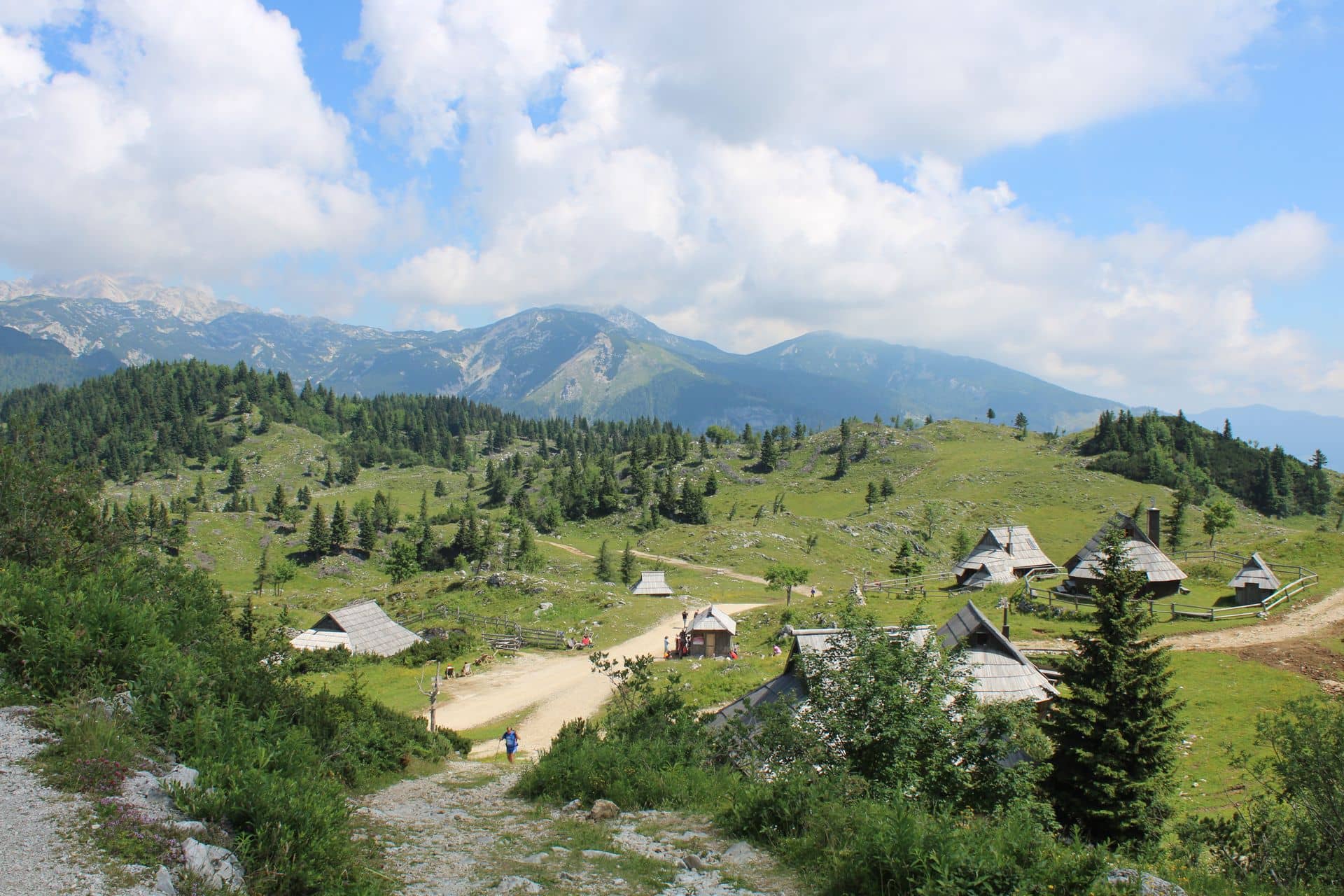
Velika Planina is a wide, high alpine pasture in the Kamnik–Savinja Alps (Kamniško–Savinjske Alpe), best known for its cluster of round-roofed shepherd’s huts and a herding tradition that still moves cattle up here every summer. Most visitors ride the cable car from Kamniška Bistrica, but the whole plateau is genuinely walkable too — nearly every route up here is graded lahka (easy), which makes it one of the most accessible high-altitude days out in Slovenia.
Where Triglav and Ratitovec are about summits and ridgelines, Velika Planina is about the plateau itself. You come up through forest, and the trees just stop — suddenly there’s a rolling green bowl scattered with dozens of squat, white-walled huts with steep wooden shingle roofs, cattle grazing between them, and a working dairy still selling fresh curd and štrukelj on weekends in summer. It’s less a mountain hike than a walk into a still-functioning piece of pastoral life, and that’s exactly why it draws families, photographers and first-time hikers who’d find Triglav’s cables intimidating.
It sits in the Slovenian Mountains category alongside those two, and it’s the one to point people toward if they want a genuine high-alpine setting without a genuinely hard day — or if they only have half a day and still want the views. If you’re deciding between the three, this is honestly the easiest starting point.
What to Expect on the Trail
If you walk up rather than ride the cable car, every established route starts the same way: a forest track climbing steadily out of the Kamniška Bistrica valley, switchbacking through spruce and beech with no real views until you’re most of the way up. It’s a genuine climb — the longest foot route gains roughly 1,000 metres from the valley floor — but the path itself stays a straightforward, well-marked trail the whole way, without cables, scree or exposed scrambling.
Then the forest simply ends and the plateau opens up. This is the part photos don’t quite prepare you for: a broad, gently rolling grassland dotted with round-roofed shepherd’s huts (oštarije), grazing cattle, and paths worn soft through short alpine turf rather than rock. Gradišče, the plateau’s high point, is a short easy walk from almost any direction once you’re up here, with a viewing platform, a bench and a summit logbook rather than anything technical.
The one route that feels like an actual mountain day is the extension to Rzenik (1,833 m), which climbs out of the valley on its own switchbacked track with a few short, distinctly steeper stretches through a narrow ravine section. It’s still officially graded easy, but it’s a longer and more serious undertaking than anything else on this list, and it’s the one place worth having proper boots and poles rather than trainers.
How Difficulty Is Graded
Slovenia’s official trail-difficulty system, set by Planinska zveza Slovenije (PZS), has three categories: lahka pot (easy path), zahtevna pot (demanding path, usually with some exposure or a fixed cable), and zelo zahtevna pot (very demanding, via ferrata-grade terrain). Slovenian trail-guide sites also use an informal fourth label, delno zahtevna (“partly demanding” — an easy route with one harder stretch), which isn’t an official PZS grade.
Velika Planina is unusual among the mountains in this category in that essentially every documented route here — from every starting point, on foot or combined with the lift — is rated lahka. There’s no zahtevna or zelo zahtevna option to warn you about, and no informal delno zahtevna label attached to any of the main approaches either, including Rzenik. That’s a genuine, source-checked fact about this hike, not an oversimplification: this really is the gentlest destination in the category so far.
- Easy — lahka označena pot
Well-graded path, no exposure. This is the grade for every established route on Velika Planina, including the Rzenik extension.
- Partly demanding — delno zahtevna označena pot (informal)
An easy route with one harder stretch. Not an official PZS grade, and not used for any current route here.
- Demanding — zahtevna označena pot
Exposure or a fixed cable. No route on Velika Planina is graded this way.
- Very demanding — zelo zahtevna označena pot
Via-ferrata-grade terrain. Doesn’t apply here — for that, see our Climbing Triglav guide.
Choose Your Route
Stahovica → Gradišče (on foot)
The full valley-to-summit approach, entirely on foot, no lift involved at any point. This is the real hike in this category — long enough to feel earned, but never technical.
Kranjski Rak → Gradišče
The most-used foot approach, with a choice of an old access road or a slightly more scenic parallel footpath — both easy, both well marked, both converging near the plateau.
Hotel Šimnovec (upper lift station) → Gradišče
What most day-trippers actually do: ride the cable car and chairlift up, then walk the last easy stretch to the viewpoint. The quickest way to stand on top.
Kraljev hrib → Rzenik (1,833 m)
A separate summit north of the main plateau, climbed on its own trail from the valley rather than from Velika Planina itself. It’s the one route here that will actually tire you out, and the views stretch toward the Triglav massif on a clear day.
A handful of shorter variants also exist — a 1-hour approach from Planina Dol, and a slightly longer one from Kraljev hrib to Gradišče itself — that aren’t worth a full card each since they cover much the same ground as the routes above; Slovenian hiking-route sites like hribi.net and kamzavikend.si list the fuller table if you want every option.
Getting to the Trailhead
There’s no toll road involved. From Kamnik, follow signs toward Kamniška Bistrica – Gornji Grad, turn off in Stahovica after about 6 km, then follow cable-car signage for another 4 km to the lower station and its large, free parking area. A bus stop at the lower cable car station is served by Arriva — worth checking their timetable directly if you’re relying on it, since services aren’t frequent.
If you’re starting one of the on-foot routes from Rakove Ravni, Ušivec or Kranjski Rak instead of the cable car station itself, those trailhead car parks charge a flat €10 per day, cash only. There’s no free alternative at those specific lots, so bring cash if you’re driving straight to the trailhead rather than parking at the main station.
What to Bring
- Sturdy walking shoes — trainers are fine for the plateau itself, but the forest approach routes are steady dirt climbs best done in real footwear.
- Sun protection and a hat — the plateau is wide open pasture with almost no shade once you’re above the treeline.
- Enough water for the climb if you’re walking up — there’s little reliable water on the ascent routes themselves.
- A light layer for the plateau — it’s exposed and catches wind even on calm valley days.
- Cash — for the trailhead parking lots, the seasonal shepherd huts selling dairy products, and useful as a backup even where cards are accepted.
- Trekking poles if you’re doing the Rzenik extension — genuinely useful on its steeper switchback sections.
When to Go
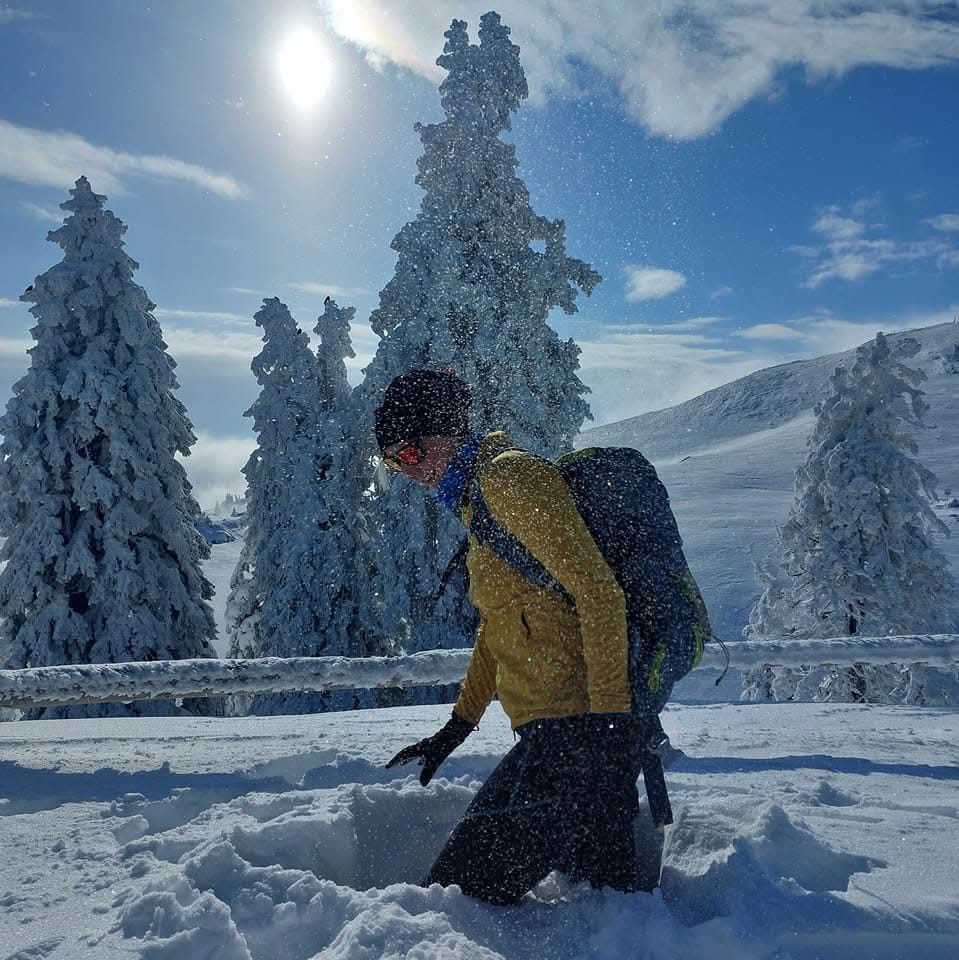
The cable car runs year-round, but the plateau looks very different depending on when you come. Late April into May brings a well-known crocus bloom across the pastures — a real draw, but stick strictly to the marked paths and don’t walk out into the flowering meadows themselves. The shepherds and their cattle are up from around mid-June to mid-September, which is also when the seasonal dairy huts open and sell fresh curd and bread for cash — outside that window the plateau is quieter and the huts themselves are closed up. Afternoon thunderstorms are common in summer, so an early start is genuinely worth it rather than just conventional advice. Winter turns the plateau into a snowshoeing and sledding destination, with the lifts still running, though access on foot becomes much harder and isn’t really the point of a winter visit here.
Safety on the Trail
The real risk here is weather and exposure on open pasture, not technical terrain. There’s very little shelter once you’re above the treeline, so an approaching afternoon thunderstorm on the open plateau is a genuinely bad place to be caught — check the forecast and start early. The cable car and chairlift themselves close during storms or strong wind, so check the timetable rather than assuming you can ride down whenever you like. Stay on marked paths: livestock graze freely across the plateau and should be given space, and the crocus meadows in spring are easily damaged by people walking through them. In an emergency, call 112, or contact Gorska reševalna zveza Slovenije (Mountain Rescue Association of Slovenia) directly.
The Hut
Koča Zeleni Rob na Veliki planini
Zeleni Rob is a proper mountain inn rather than a bivak-style dom, and it’s the reliable, year-round anchor of the plateau — open even outside the summer shepherd season, when most of the smaller dairy huts are shut.
Velika Planina doesn’t have a classic PZS-style hut with shared dorm beds. Overnight stays instead mean renting one of the plateau’s traditional herder’s cottages individually — there are roughly nine available for rent, each booked separately rather than through a single central reservation system, and prices vary widely depending on the cottage and season. It’s a genuinely different kind of overnight than staying at Krekova koča on Ratitovec or Triglavski dom on Triglav, so don’t expect to just show up and book a bunk the same way.
Day Hike or Overnight?
The overwhelming default, and genuinely the right call for most people. Whether you ride the lift, walk up from Kranjski Rak, or do the full Stahovica climb, the whole plateau — huts, Gradišče viewpoint, Preskar museum — is comfortably doable between morning and late afternoon, with the last cable car back down covering you if your legs give out before your enthusiasm does.
Worth it specifically for the light — sunset and sunrise over the empty pasture, once the day-trip crowds have gone down on the last lift, are the real reason to stay. It means booking one of the individual herder’s cottages in advance rather than a shared hut bunk, and costs noticeably more than a standard mountain-hut night, so it’s really a deliberate choice rather than a natural extension of the day hike.
More Ways to Experience Velika Planina
Partner content — the widget below is provided by Viator, one of our booking partners. Browsing or booking through it supports Tips in Slovenia at no extra cost to you.
Frequently Asked Questions
Do I need to take the cable car to Velika Planina?
No. The cable car is the fastest and most popular way up, but every part of the plateau is reachable on foot as well, with routes from Stahovica, Kranjski Rak and Kraljev hrib all rated easy. Plenty of visitors walk up one way and ride the lift down, or the reverse.
Is Velika Planina difficult to hike?
Not by Slovenian mountain standards. Every established route here is graded lahka (easy) by PZS’s own system, with no cables or exposed scrambling anywhere in the main route network. The longest foot approach from Stahovica gains around 1,000 metres, so it’s a real physical climb, but not a technical one.
When are the shepherds and their cattle actually up on the plateau?
Roughly mid-June to mid-September, which is also when the seasonal dairy huts open and sell fresh curd, cheese and bread for cash. Outside that window you’ll still see the round-roofed huts themselves, but the plateau is quieter and most of the small huts are closed.
Can I stay overnight on Velika Planina?
Yes, but not in a typical shared mountain-hut bunk. Overnight stays mean renting one of roughly nine traditional herder’s cottages individually, booked separately rather than through one central system, at a noticeably higher cost than a standard PZS hut night.
Is Velika Planina worth visiting outside summer?
Yes, in different ways. Late April into May brings a crocus bloom across the pastures (stay off the flowering meadows themselves), and winter turns the plateau into a snowshoeing and sledding destination with the lifts still running. The working shepherd’s village itself, though, is really a summer thing.
More to read
Fresh from Slovenia Travel Tips
Thermal Spas in Slovenia: The Best Terme for a Winter Visit
Quick answer: Slovenia’s thermal spas (terme) stay open all winter, but what’s actually usable varies a lot by…
Slovenia Travel in December: Weather, Crowds, Hiking and What to Expect
December is when Slovenia goes fully festive and genuinely cold — lift-served skiing begins at the lower resorts,…
Christmas Markets in Slovenia Beyond Ljubljana: Ptuj, Kranj, Bled, Maribor and Celje
Quick answer: Ljubljana isn’t the only Slovenian city with a festive December program. Ptuj, Kranj, Bled, Maribor and…
Part of our Slovenian Mountains guide. If you want an actual summit day rather than a plateau walk, see Climbing Triglav, or for something in between — a proper hike that’s still easy grade — see our Ratitovec guide.

Related guides
 Pokljuka: Hiking, Biathlon and Cross-Country Skiing on Slovenia’s High PlateauPokljuka is a forested karst plateau in the Julian Alps, about 15 km west of Bled and part…
 Viševnik: Routes, Difficulty and Slovenia’s Easiest Two-ThousanderViševnik (2,050 m) is routinely named the most-visited peak above 2,000 m in Slovenia — not because it’s…
 Skiing in Slovenia: Resorts, Piste Lengths and 2026/27 Opening DatesSlovenia’s ski season normally runs from late November to late March, spread across eleven resorts from the high…