Portorož Travel Guide: Slovenia’s Spa and Beach Resort
by Darja · Published Sep 21, 2026 · 8 min read
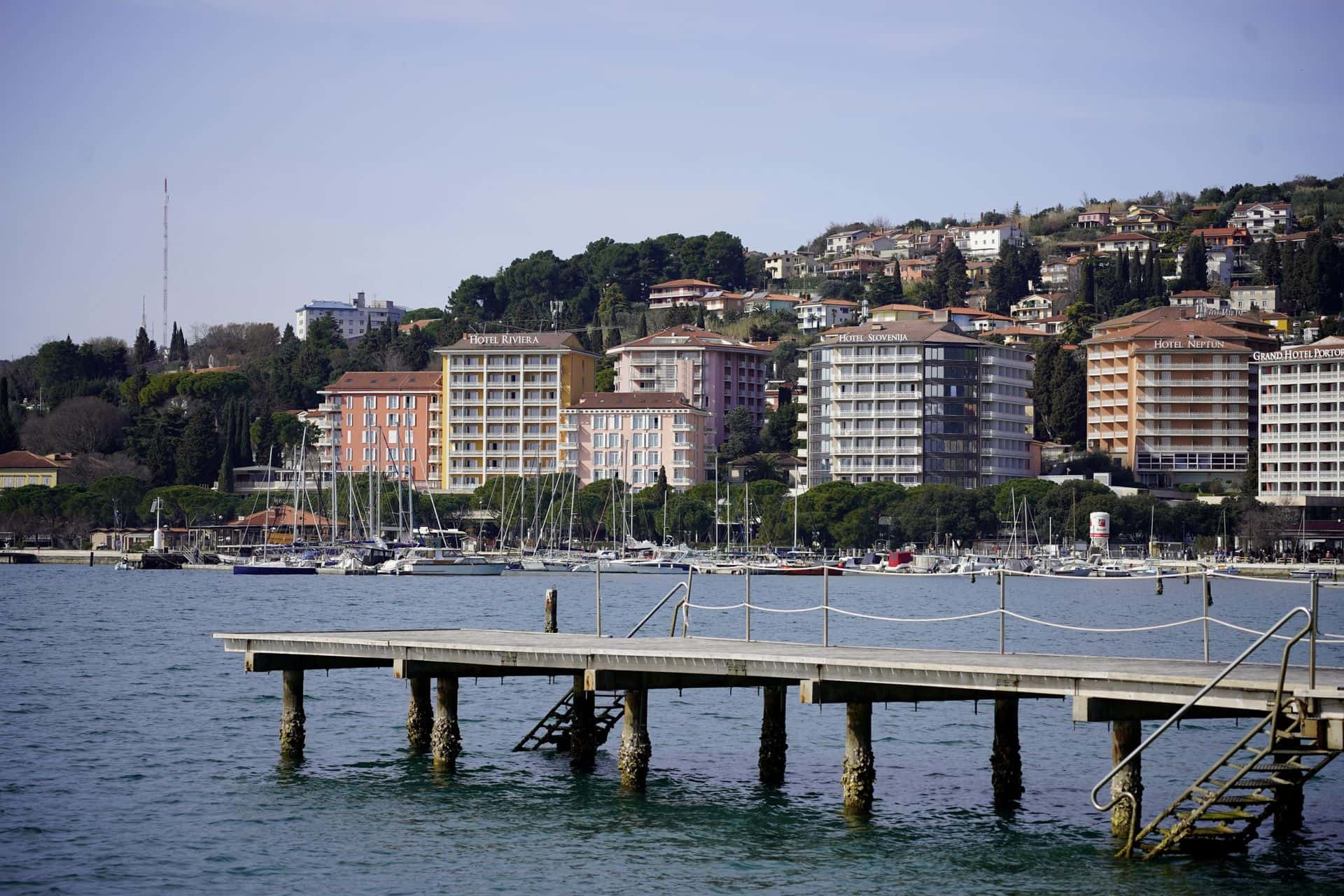
- PopulationAbout 2,850 (2002 census, the last published count for the settlement)
- Spa traditionSince 1879, seawater and salt-mud treatments
- Known forBeaches, spa hotels and the casino strip
- How many days?1, easily combined with Piran or Izola
- Best months to visitMay-June and September, to avoid August
- From Ljubljana~120 km, about 1 hr 30 min
Portorož has no medieval old town to wander — it is a resort, built for exactly one purpose, and it has been doing that job since the 1870s.
The name is Slovene for “port of roses,” from the Italian Portorose: the bay was recorded as Portus sanctae Mariae de Rosa in 1251, after a church dedicated to Santa Maria delle Rose that once stood here. Nothing of that early settlement survives above ground — what you see today is almost entirely a purpose-built spa and beach town that grew up from the 1870s onward around the belief that the local seawater and salt-mud were good for you.
It is one of the guides in our section on Slovenian cities, and sits on the Slovenian coast, a few minutes down the road from Piran.
A Brief History of Portorož
Roman-era farms and villas stood on this stretch of coast after the conquest of Istria in 178 BC, and by the 12th century the area held four monasteries. One of them, the Benedictine monastery of St Lawrence, is recorded treating rheumatic illness with concentrated saltwater and saline mud — the same therapy the town still markets today, seven or eight centuries later.
The modern resort began in 1879, when Giovanni Lugnano started offering seawater cures on the site. Word travelled fast: by the early 1900s Portorož was ranked alongside Opatija and Grado as one of the grandest resorts on the Austro-Hungarian Adriatic — the empire’s answer to the French Riviera. The centrepiece was the Palace Hotel, built 1908–1912 and opened on 20 August 1910 to reviews calling it the most beautiful hotel on the Adriatic. It was declared a cultural monument in 1983, closed in 1990, and reopened in 2008 after a roughly €70 million restoration — run by Kempinski until early 2026, when management passed to Minor Hotels.
Gambling arrived in 1913 with what is still Slovenia’s oldest casino, and it took on an odd second life under socialist Yugoslavia: ordinary gambling was tightly restricted, but Portorož was kept as one of a handful of coastal exceptions where casinos ran openly to draw Western tourists and their hard currency. The town’s international profile peaked in 1958, when the Portorož chess tournament saw a 15-year-old Bobby Fischer earn his grandmaster title (Mikhail Tal won the event outright). The high-rise Bernardin resort and the marina, converted from the old Lucija saltworks, both date from the mid-to-late 1970s, by which point Portorož looked more or less as it does now.
Top Attractions
The Palace Hotel
Built 1908–1912 by the Austrian architect Johann Eustacchio and opened in 1910, this is the building that put Portorož on the map for Habsburg-era travellers. It closed in 1990, sat empty for most of two decades, and reopened in 2008 after an extensive restoration. Whatever brand ends up on the façade next, the building itself — a protected cultural monument since 1983 — is worth a look even if you are not staying there.
Forma Viva Sculpture Park
Out on the Seča peninsula sits the original Forma Viva, founded in 1961 as the first of what became a network of open-air stone-sculpture symposiums across former Yugoslavia. Sculptors from around the world carved directly into blocks of white Istrian limestone; more than 300 pieces came out of the Portorož symposium over the decades, some of which remain scattered through the pines here with sea views on three sides.
The Seafront Promenade
A long, level walking and cycling strip runs the length of the town along the water, from the marina at Lucija past the hotel strip toward Piran. It is the town’s real public space — where the beach clubs, ice-cream stands and the evening passeggiata all happen — and it is flat enough to cover the whole town on foot or on a rented bike.
Grand Casino Portorož
Opened in 1913 and still Slovenia’s oldest operating casino, this is a genuine piece of the town’s history, not a modern addition. Under Yugoslavia, when gambling was tightly restricted almost everywhere else in the country, Portorož was deliberately kept open as a hard-currency draw for Western visitors — part of why the town developed such an outsized reputation for a place its size.
Portorož Hidden Gems
The Ruins of St Bernardin’s Monastery
Long before the high-rise St Bernardin Resort was built in the 1970s, a Franciscan church and monastery stood on the same ground, consecrated in 1452 — by tradition the first church in the world dedicated to St Bernardin of Siena, built after the reformist friar John of Capestrano preached here in 1451. The monastery was later abandoned and its library lost, but the ruined foundations of the church and cloister are still there among the resort grounds, a genuinely old fragment inside Portorož’s newest-looking neighbourhood.
The Rolling Stones Museum
An unlikely private museum on Podvozna street, built up over decades by a former ship’s engineer, Slavko Franca, from his own collection: around a thousand pieces of Rolling Stones memorabilia, including a guitar pick Keith Richards once threw him at a concert in Belgium. VH1 named it one of the “10 Truly Insane Music Museums” in 2013, and it is exactly as niche and sincere as that sounds.
Lucija Marina
At the quiet end of the promenade, away from the beach clubs, the marina fills what used to be the Lucija saltworks — converted to moorings in 1977. Walking out here past the working boatyards is a different, much less crowded side of the town than the hotel strip a few hundred metres away.
Day Trips
| Destination | Distance | Drive time | Best for |
|---|---|---|---|
| Piran | ~3 km | ~10 min | Venetian old town, closed to cars |
| Izola | ~10 km | ~15 min | A quieter working fishing harbour |
| Sečovlje salt pans | ~8 km | ~15 min | Working salt pans and a nature park |
| Koper | ~20 km | ~28 min | The coast’s working port and largest town |
Piran (3 km)
Everything Portorož does not have — a compact Venetian old town, closed entirely to cars, with narrow stone streets and Tartini Square at its centre. Read the full Piran travel guide; most visitors to this stretch of coast use one town as their base and treat the other as a ten-minute day trip.
Izola (10 km)
A smaller, quieter fishing town a little further up the coast, with a working harbour instead of a beach-club strip. Read the full Izola travel guide if you want a slower, less polished contrast to Portorož.
Getting Around
Parking here is easy, which is unusual for this coast. Unlike Piran, Portorož was built with cars in mind — hotels have their own lots and there is metered parking along the promenade, though it fills up in August.
The promenade itself is flat and walkable end to end, and a summer tourist train and local buses connect the hotel strip with Piran and Lucija for anyone who does not want to drive between them.
Buses run along the coast to Izola, Koper and inland to Ljubljana. There is no railway station on this part of the coast; a small regional airport a few kilometres south in Sečovlje handles limited seasonal and charter traffic, so most visitors fly into Ljubljana or Trieste and drive the rest of the way.
Portorož Travel Guide – Tips
Come for the beach and the spa, not an old town. Portorož does not have one, and expecting Piran’s architecture here is the single most common disappointment travellers report. Come knowing what this town actually is and it delivers exactly that.
Book spa and wellness treatments ahead in July and August. The hotels’ thalassotherapy and wellness centres, the direct descendants of the 1879 seawater cures, get booked out in peak season.
Base here for comfort, base in Piran or Izola for character. Portorož has the newer hotels, the casino and the flattest, easiest walking; the two neighbouring towns have the old streets. All three are close enough that which one you sleep in matters less than it seems.
FAQ
Is Portorož worth visiting?
Yes, for a specific kind of trip: beach time, spa and wellness, and comfortable modern hotels, all within a few minutes of Piran’s old town if you want a change of pace. It is not the place to go looking for medieval architecture — that is what Piran and Izola are for.
Should I stay in Portorož or Piran?
Portorož has the newer hotels, easier parking and the spa and casino scene; Piran has the historic old town but is closed to cars and has fewer big hotels. Both are about ten minutes apart, so many visitors stay in one and simply visit the other.
Does Portorož have a sandy beach?
Not a wide natural sand beach in the way some visitors expect. The town’s bathing areas along the promenade are a mix of concrete platforms, piers and grassy sunbathing lawns rather than one long sandy shore — still swimmable and well set up with beach clubs, just not what “beach” means on, say, an Italian Adriatic resort.
Is Portorož the same place as Piran?
No, though they are only about 3 km apart and both sit inside the Municipality of Piran, which has no separate town council for Portorož itself. Piran is the old Venetian town on its own peninsula; Portorož is the newer resort strip that grew up along the bay next to it.
How do I get from Ljubljana to Portorož?
About 120 km, roughly an hour and a half by car, similar to the drive to Piran. There is no direct train; the bus goes via Koper, or you can fly into Ljubljana and drive the rest of the way.
More Ways to Experience Portorož
Partner content — the widget below is provided by Viator, one of our booking partners. Browsing or booking through it supports Tips in Slovenia at no extra cost to you.
Read the guides to Piran, Izola and Koper, all a few minutes up the coast. More on Slovenia’s cities: read the guides to Ljubljana, Maribor, Celje, Ptuj and Bled, see the whole Slovenian coast, or start planning the wider trip at Tips in Slovenia.

Darja
Writes destination guides for Tips in Slovenia, covering the country's cities, hidden gems and day trips.
Related guides
 Slovenian Cities · 16 Oct 2026Kranjska Gora Travel Guide: Skiing, Hiking and the Vršič PassKranjska Gora is Slovenia's ski town and alpine hiking base: the Vitranc World Cup course, Planica's ski flying…
 Slovenian Cities · 13 Oct 2026Koper Travel Guide: Slovenia’s Historic Port CityKoper was an island until 1825. What to see in Slovenia's only international port city, and how to…
 Slovenia Travel Tips · 12 Oct 2026Christmas and New Year in Ljubljana: What to KnowWhen Ljubljana's lights go on, what closes for Christmas and New Year, and what the weather is really…
Newsletter
Don't miss anything new
One new Slovenia guide in your inbox every couple of weeks. No spam, unsubscribe any time.