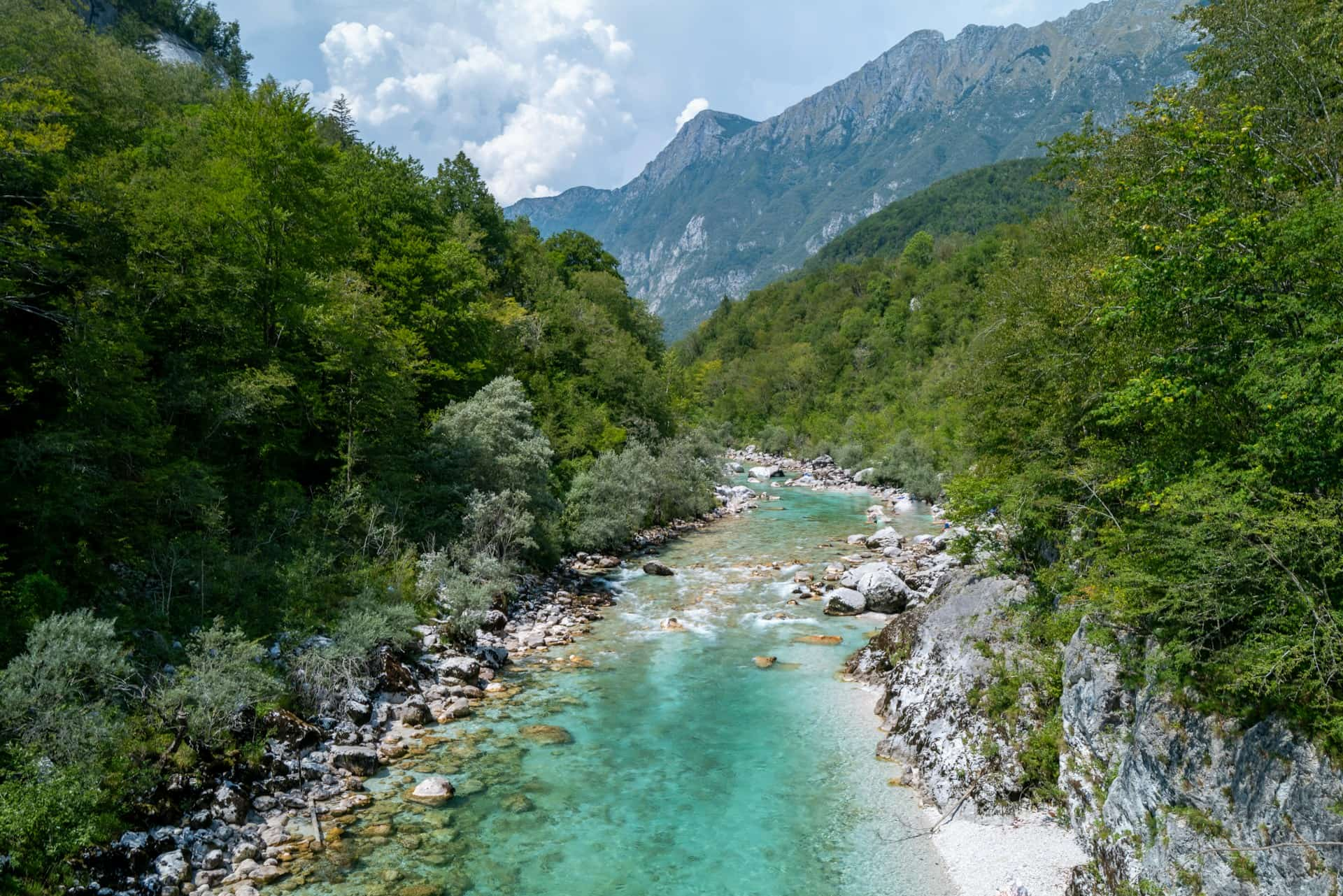
Five days is enough to go beyond the classic Ljubljana-and-Bled loop — but only if you commit to one direction instead of trying to cover everything. This itinerary heads north into the Julian Alps: Ljubljana, Lake Bled, and two full days in the Soča Valley for rafting, gorges and mountain scenery. Unlike the rest of our itinerary series, this one genuinely needs a rental car — public transport to Bovec and Kobarid is too thin to build a trip around.
If you’ve read our 3-day itinerary, you already know the honest version of that trip stops at Ljubljana, Bled and Postojna Cave. Five days is enough room to go further — not by adding more of the same, but by heading into the Julian Alps for the Soča Valley, Slovenia’s whitewater river and one of its most dramatic landscapes. If you’d rather stay car-free and add the coast instead, our 7-day itinerary without a car covers that route. This one is different: part of the drive itself, over the Vršič Pass, is one of the reasons to come.
Before You Go: Why This One Needs a Car
Every other itinerary on this site is built around Slovenia’s bus and train network, and that’s deliberate — it genuinely works for Ljubljana, Bled, Postojna and the coast. The Soča Valley is the exception. Bovec and Kobarid are connected to the rest of the country by limited, seasonal bus routes — in practice, often a single afternoon departure — which isn’t something to build a 5-day trip around.
Rent a car in Ljubljana, at the airport or in town, rather than relying on public transport for this one. For the basics of driving here, including the motorway vignette you’ll need, see our Driving in Slovenia guide.
Partner link — booking through this link supports Tips in Slovenia at no extra cost to you.
Compare rental car prices for SloveniaYour 5-Day Slovenia Itinerary
Ljubljana, one night in Bled, and two full days based in the Soča Valley.
Ljubljana
Arrive, settle in, and spend the rest of the day in one of Europe’s most walkable capitals.
🚆 Getting there
If you’re flying in, most major rental companies have a desk at Ljubljana Jože Pučnik Airport. You don’t need the car today — Ljubljana’s center is pedestrianized, so picking it up tomorrow morning instead is often simpler. Bus 28 (Arriva) runs from the airport into the city roughly once an hour if you’d rather leave the car for Day 2.
⏱ How long it takes
The airport bus takes around 50 minutes. Once you’re in the city, everything worth seeing today is within a 20-minute walk.
💰 Approximate cost
The airport bus runs around €3.30 on weekdays. Rental car rates vary by season and company — compare prices before you commit.
🏨 Where to stay
Base yourself near the Old Town or Prešeren Square. If you’re picking up a rental car tomorrow, check whether your hotel has parking — the historic center itself is largely car-free.
📍 What to do
Walk the riverside promenade along the Ljubljanica, take the funicular up to Ljubljana Castle for the skyline view, and browse the Central Market before an early dinner. Our Ljubljana travel guide has the full rundown if you want more than a half-day here.
⚠️ Watch out for
Don’t schedule anything time-sensitive right after landing — flight delays plus the airport transfer can eat your whole afternoon.
Ljubljana → Bled
Pick up your car this morning and drive north to Slovenia’s most photographed lake.
🚆 Getting there
A straightforward drive north on the A2 motorway. You’ll need a vignette (toll sticker) for Slovenia’s motorways — see our Driving in Slovenia guide for where to get one.
⏱ How long it takes
Around 45–50 minutes by car, door to door.
💰 Approximate cost
Just fuel and the motorway vignette for this leg — no separate transport ticket needed now that you’re driving.
🏨 Where to stay
One night in Bled, ideally within walking distance of the lake.
📍 What to do
Walk the lake path, take the pletna boat out to the island church, and climb up to Bled Castle for the classic viewpoint. Our Bled travel guide covers the full route, boat and castle costs, and the best viewpoints in detail.
⚠️ Watch out for
Parking near the lake fills up fast in peak season. Arrive early, or use one of the signed lots a short walk from the old center instead of circling for a closer spot.
Bled → Soča Valley (via Vršič Pass)
The drive itself is the highlight today — over Slovenia’s highest mountain pass and down into the Soča Valley.
🚆 Getting there
The Vršič Pass tops out at 1,611m, with 50 numbered hairpins along the way. It’s typically open from late May to November, depending on snowfall — check current conditions before you travel. If it’s closed, or you’d rather skip the hairpins, the lower route via Idrija and Tolmin is open year-round.
⏱ How long it takes
Around 2 hours via the pass without stopping — but allow 3 to 4 hours if you stop at the Russian Chapel and the summit viewpoint, which is worth doing. The lower route takes roughly 2.5 to 3 hours.
💰 Approximate cost
No extra toll for the pass itself — just the fuel and vignette you’re already covering.
🏨 Where to stay
Bovec or Kobarid for the next two nights — see the comparison below.
📍 What to do
Settle in, and if there’s daylight left, the Kozjak Waterfall near Kobarid is an easy, family-friendly walk — about an hour round trip from the car park. Admission is a few euros, cash only.
⚠️ Watch out for
The Vršič Pass is a genuinely serious mountain road — slow hairpins, and no barriers in places. Don’t attempt it in fog, snow or after dark if you’re not used to mountain driving; take the lower route instead if conditions look uncertain.
Soča Valley: Rafting, Gorges and History
A full day based in Bovec or Kobarid — water in the morning, a gorge or a museum in the afternoon.
🚆 Getting around
Bovec, Kobarid and Tolmin sit close together — about 20 minutes apart by car — so you can base yourself in one and still reach the others easily today.
⏱ How long it takes
Guided rafting runs a half-day, 3 to 4 hours including kit and the safety briefing. Tolmin Gorge is about 1.5 hours of walking; the Kobarid Museum is closer to an hour. Pick one for the afternoon rather than both.
💰 Approximate cost
Rafting runs roughly €45–60 per person. Tolmin Gorge entry is around €8 in the off-season, €12 in peak season (June–September). The Kobarid Museum is around €8 for an adult.
🏨 Where to stay
Same base as last night.
📍 What to do
Morning rafting on the Soča — Class II–III water, no experience needed, full safety gear included. In the afternoon, choose between the walkways and waterfalls of Tolmin Gorge, or the Kobarid Museum’s account of the WWI Isonzo Front, one of the more sobering museums in the country.
⚠️ Watch out for
Rafting trips fill up fast in July and August, exactly when the water is warmest and most forgiving — book ahead. And don’t underestimate the cold: even in August the Soča rarely rises above 15°C.
Soča Valley → Ljubljana → Departure
Back over the lower route, with time built in for the drive, the rental return and your flight.
🚆 Getting there
Drive back via the lower route through Idrija and Tolmin — simpler than retracing the Vršič Pass, and open regardless of season.
⏱ How long it takes
Roughly 2.5 to 3 hours to Ljubljana. Add time for returning the rental car and airport procedures — mountain roads tend to run slower than GPS estimates, especially behind traffic in high season.
💰 Approximate cost
Standard fuel and vignette costs. If you’re returning the car to the airport rather than where you picked it up, check whether that carries a one-way drop-off fee.
🏨 Where to stay
Departure day — no overnight needed.
📍 What to do
If you’ve got a few spare hours before your flight, a short stop in Ljubljana’s Old Town on the way through is an easy way to use them.
⚠️ Watch out for
Don’t cut the return drive too close to your flight time — build in buffer rather than planning against the shortest possible estimate.
Where to Stay in the Soča Valley: Bovec or Kobarid?
Both work well as a base for Days 3 and 4 — the choice comes down to what you’d rather be closer to.
Bovec
Closer to the water- Right in the middle of the adventure-sports scene, close to the rafting put-ins and Bovec’s canyoning operators.
- Livelier in summer, with more outfitters clustered in one small town.
- The natural choice if you’re arriving over the Vršič Pass from the north.
Kobarid
Quieter, more history- The Kobarid Museum and Napoleon’s Bridge are both a short walk from the center.
- Slightly closer to Tolmin Gorge.
- A good choice if WWI history and a calmer base matter more to you than being steps from the rafting office.
5-Day Slovenia Cheat Sheet
The key legs of this itinerary, at a glance — treat every time, price and opening date here as approximate and check current conditions before you travel.
| Route | Transport | Approx. time | Difficulty |
|---|---|---|---|
| Ljubljana Airport → City Center | Car or Bus (Arriva 28) | ~35–50 min | Easy |
| Ljubljana → Bled | Car | ~45–50 min | Easy |
| Bled → Soča Valley (via Vršič, late May–Nov) | Car | ~2h (3–4h with stops) | Moderate — mountain pass |
| Bled → Soča Valley (lower route, year-round) | Car | ~2.5–3h | Easy |
| Soča rafting (half-day) | Guided | 3–4h incl. briefing | Easy — no experience needed |
| Soča Valley → Ljubljana | Car (lower route) | ~2.5–3h | Easy |
The Biggest Mistakes People Make in 5 Days
Assuming the Vršič Pass is open whenever you’re traveling
It typically closes from late autumn through spring depending on snowfall, roughly late May to November in most years. Check current conditions before you count on it, and know the lower route via Idrija and Tolmin as a year-round backup.
Not renting a car
Unlike the rest of this site’s itineraries, this one genuinely needs one — the Soča Valley’s public transport is too limited to build a trip around.
Trying to add Lake Bohinj or the coast on top
Five days is enough for Ljubljana, Bled and the Soča Valley done properly. Squeezing in more usually means rushing all of it — see our 7-day itinerary if you want those too.
Not booking rafting in advance for July or August
Trips fill up fast exactly when the water is warmest and most forgiving — which is when everyone wants to go.
Underestimating the cold water
Even in August the Soča rarely rises above 15°C. A wetsuit — included on guided trips — isn’t optional.
Only planning one day in the Soča Valley
Between the drive in, rafting, and a gorge or museum visit, it genuinely needs the better part of two days — Day 3 afternoon plus all of Day 4.
Driving the Vršič Pass in bad weather or after dark without experience
The hairpins are manageable in good conditions but a poor place to learn mountain driving. Take the lower route if conditions look uncertain.
Only Have 3 Days, or Want to Stay Car-Free?
This itinerary trades the simplicity of public transport for the Julian Alps and the Soča Valley — a genuinely different kind of trip. If you’ve only got a long weekend, our 3-day itinerary sticks to Ljubljana, Bled and Postojna Cave by bus. If you’d rather stay car-free for longer and add the coast instead of the mountains, see our 7-day itinerary without a car.
Guided Rafting or Self-Guided Valley Time?
Guided Rafting Trip
What this itinerary assumes- No experience needed — a guide runs the trip and full safety gear (helmet, life vest, wetsuit) is included.
- The standard way nearly everyone experiences the Soča, and the simplest to book ahead from home.
- Fixed departure times, so it anchors your morning around the trip rather than the other way round.
Independent Kayaking
For experienced paddlers only- Water levels on the Soča move with snowmelt and rainfall, not a dam release — come with real river skills or book a coached course instead.
- More flexible timing if you know what you’re doing.
- Not a reasonable way to try whitewater paddling for the first time.
Ready to get on the water?
A half-day guided rafting trip on the Soča, bookable through our partner Viator. Booking through this link supports Tips in Slovenia at no extra cost to you.
Who Is This Itinerary Good For?
Great for
- Travelers who want mountains and adventure, not just lakes and cities.
- Anyone comfortable driving abroad, including a genuine mountain pass.
- A Julian Alps-focused trip rather than a checklist of the classic sights.
Less suitable for
- Anyone who’d rather not drive — see our car-free 7-day itinerary instead.
- Travelers set on also seeing the coast or Lake Bohinj in the same trip.
- Anyone uneasy about mountain roads or looking for a low-logistics, relaxed trip.
Frequently Asked Questions
Is 5 days enough for Slovenia?
Enough for Ljubljana, Bled and a proper two days in the Soča Valley. It’s not enough to also add the coast or Lake Bohinj — see our 7-day itinerary for that.
Do I need to rent a car for this itinerary?
Yes. Unlike the rest of this site’s itineraries, this one requires a car — the Soča Valley’s public transport is too limited, often a single seasonal bus, to plan a trip around.
Is the Vršič Pass open year-round?
No. It typically closes from late autumn through spring depending on snowfall, roughly late May to November in most years. Always check current conditions before you travel, and know the lower route via Idrija and Tolmin as a year-round alternative.
Is rafting on the Soča suitable for beginners?
Yes — the standard guided half-day trip (Class II–III water) needs no experience and includes a guide and full safety gear. Independent kayaking is different, and only advisable for experienced paddlers.
Should I stay in Bovec or Kobarid?
Both work well. Bovec is closer to the rafting put-ins and has more adventure-sports outfitters; Kobarid is quieter, with more historical character, and is a short walk from the WWI museum.
Can I combine this itinerary with the coast or Lake Bohinj?
Not comfortably in 5 days. Either one is worth adding, but doing so usually means rushing the Soča Valley, which is most of the point of this trip. See our 7-day itinerary if you want to include them.
What’s the best time of year for this itinerary?
Roughly June to September, when the Vršič Pass is reliably open and the water is warm enough to actually enjoy rather than just survive. Late spring brings the biggest whitewater, but also the coldest water and the most pass-closure risk.
More Ways to Experience This Itinerary
Partner content — these bookable experiences (Ljubljana, Bled and the Soča Valley) are provided through our partner Viator. Booking through these links supports Tips in Slovenia at no extra cost to you.
More to read
Fresh from Slovenia Travel Tips
Thermal Spas in Slovenia: The Best Terme for a Winter Visit
Quick answer: Slovenia’s thermal spas (terme) stay open all winter, but what’s actually usable varies a lot by…
Slovenia Travel in December: Weather, Crowds, Hiking and What to Expect
December is when Slovenia goes fully festive and genuinely cold — lift-served skiing begins at the lower resorts,…
Christmas Markets in Slovenia Beyond Ljubljana: Ptuj, Kranj, Bled, Maribor and Celje
Quick answer: Ljubljana isn’t the only Slovenian city with a festive December program. Ptuj, Kranj, Bled, Maribor and…

Related guides
Thermal Spas in Slovenia: The Best Terme for a Winter VisitQuick answer: Slovenia’s thermal spas (terme) stay open all winter, but what’s actually usable varies a lot by…Slovenia Travel in December: Weather, Crowds, Hiking and What to ExpectDecember is when Slovenia goes fully festive and genuinely cold — lift-served skiing begins at the lower resorts,…Christmas Markets in Slovenia Beyond Ljubljana: Ptuj, Kranj, Bled, Maribor and CeljeQuick answer: Ljubljana isn’t the only Slovenian city with a festive December program. Ptuj, Kranj, Bled, Maribor and…