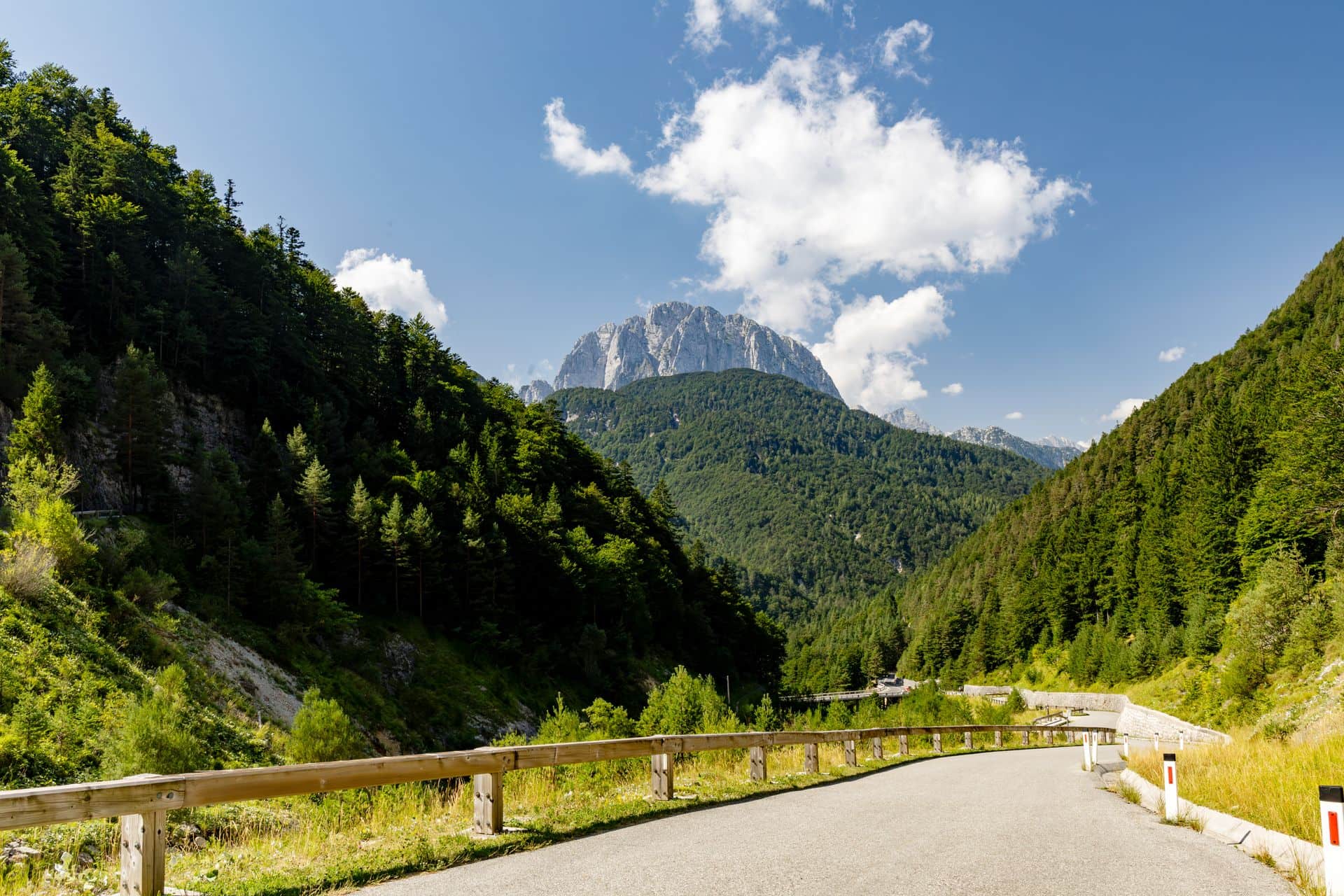
Driving in Slovenia is generally straightforward for tourists once you know a handful of essentials: buy an e-vignette before joining any motorway or expressway, respect the posted speed limits, and give mountain roads like the Vršič Pass more time and attention than you would at home. The road network is well signed and well maintained, and most visitors who prepare a little in advance find it easy going — the mistakes that actually catch people out are almost always about the vignette, parking, or underestimating a mountain pass.
A car opens up parts of Slovenia that public transport barely reaches — quiet Alpine valleys, small wine villages, and mountain roads with no bus line in sight. If you’re still weighing the two options, that itinerary breaks down exactly what public transport can and can’t cover; this guide picks up once you’ve decided a car is coming with you. The reassuring part: driving here is refreshingly manageable by European standards, provided you know what’s coming before you turn the key. This is part of our Slovenia Travel Tips series.
Partner link — booking through GetRentacar supports Tips in Slovenia at no extra cost to you.
Compare rental car prices for Slovenia
Before You Start Driving in Slovenia
A quick checklist of everything worth sorting out before you leave the rental desk — each point is covered in full further down.
E-vignette
Needed on every motorway and expressway. It’s linked to your number plate, not a paper sticker, so the details have to match exactly.
Driving licence
A licence from the US, Canada, UK or most other countries is normally accepted for a short visit; an International Driving Permit is a sensible backup to carry alongside it.
Rental car documents
Keep the rental agreement, registration document and proof of insurance in the car — police can ask to see them at a routine stop.
Parking
Free street parking is rare in any tourist town. Have coins or a parking app ready rather than assuming an empty space is free.
Speed limits
50 km/h in towns, 90 on the open road, 110 on expressways, 130 on motorways — posted signs always override these defaults.
Mountain roads
Narrow, winding, and shared with cyclists, buses and the occasional grazing animal. Budget more time than the map suggests.
Tunnels
Slovenia’s motorways run through several tunnels. Dipped headlights and a longer following distance than usual.
Fuel
Fill up before heading into the mountains or along quieter coastal roads — village stations can be few and far between.
Emergency number
112 for police, fire or ambulance anywhere in Slovenia. AMZS roadside assistance runs on 1987.
What to do if you receive a fine
Don’t ignore it — it gets more expensive, not less. See the dedicated section further down this guide.
Slovenia E-Vignette: Who Needs One and How It Works
Slovenia charges for motorway and expressway use through an e-vignette (e-vinjeta) rather than a toll booth — there’s no barrier to stop at, just automatic number-plate recognition along the road. Every car, motorcycle and van up to 3.5 tonnes needs one before it touches a motorway or expressway; regular roads, towns and mountain passes like the Vršič don’t require it at all.
The e-vignette is tied entirely to your registration plate rather than a sticker on the windscreen, which is the detail that trips visitors up most often. When you buy it — through the official DARS webshop, at larger petrol stations, or through recognised resellers — you enter the plate number and country of registration yourself, and if that entry doesn’t match the car actually on the road, the system treats the toll as unpaid even though you genuinely bought one. Double-check the plate before you confirm the purchase.
Vignettes come in weekly, monthly and annual options. For an ordinary passenger car (the 2A category, up to 1.3 m in height above the front axle), the going rate at the time of writing is roughly €32 for a week, €64 for a month and €235 for a year — prices are adjusted periodically, so treat these as a guide and check the current figure on the DARS site before you buy. Motorcycles and taller vehicles sit in their own, separate price bands.
Do rental cars in Slovenia already have a vignette?
Many rental companies based in Slovenia already include the e-vignette on cars that stay within the country, but this isn’t universal — and it’s especially worth checking if you’re picking the car up somewhere else, like Zagreb, Trieste or Venice, and driving into Slovenia. Ask the rental desk directly and, if possible, get the answer confirmed on the rental agreement rather than assuming.
One more distinction worth having straight: the Slovenian e-vignette only covers Slovenian motorways and expressways. Cross into Austria, Italy or Croatia and you’ll need that country’s own vignette or toll system — the Karavanke tunnel toward Austria is a common place this catches people out, since the Slovenian side is covered by your e-vignette but the Austrian side isn’t.
Speed Limits and Basic Driving Rules in Slovenia
| Road type | Typical speed limit |
|---|---|
| Built-up areas | 50 km/h |
| Roads outside built-up areas | 90 km/h |
| Expressways | 110 km/h |
| Motorways | 130 km/h |
Posted signs always take precedence over these defaults — a village, a work zone or a mountain bend will often carry a lower limit than the road type would suggest. A few other rules that catch visitors out:
- Seatbelts are required for everyone in the car, front and back.
- Dipped headlights or daytime running lights are required at all times, even in bright daylight.
- The blood alcohol limit is 0.5‰ (0.05%) for most drivers, and zero for drivers under 21, anyone in their first two years of holding a licence, and professional drivers.
- Using a handheld phone while driving is illegal and carries a fine.
- Overtake only on the left, and only where it’s clearly permitted.
- At unmarked junctions, traffic coming from the right generally has priority; at roundabouts, give way to vehicles already circulating and signal as you leave.
- Winter equipment — winter tyres, or summer tyres with snow chains carried in the car — is required from 15 November to 15 March, and at any other time conditions call for it.
What Are the Roads Like in Slovenia?
Motorways and expressways connect the country’s main hubs and are modern, well-surfaced and fast — Ljubljana to the coast or to Maribor runs almost entirely on motorway, and Ljubljana to Bled uses a mix of motorway and a well-kept regional road for the final stretch.
Regional roads are usually a single lane in each direction and pass straight through the centre of every village along the way, each with its own lower speed limit. A 40 km regional drive can easily take longer than the distance implies — build in a buffer rather than trusting a straight-line estimate. This is also the kind of road you’ll be on for an easy day trip from Ljubljana to Postojna Cave or the Škocjan Caves — straightforward driving, just don’t rush it.
Narrow local roads around villages and farmland can be barely wide enough for two cars to pass. Slow down, expect oncoming tractors, and be ready to pull into a passing space rather than expecting the other driver to.
Mountain roads are a category of their own, and worth their own section — see below.
Driving in the Slovenian Mountains
Slovenia’s mountain roads are where a bit of preparation pays off most. Expect steep gradients, tight bends and narrow sections with occasional passing places rather than a full second lane. You’ll share the road with touring cyclists on some of the most scenic climbs, with buses and coaches on a handful of popular routes, and — especially around dawn and dusk — with deer or livestock wandering onto the tarmac. Weather can flip fast at altitude: a clear morning can turn to fog or rain within the hour, and fog tends to pool in the valleys below. After heavy rain, watch for loose gravel or minor rockfall on the tighter climbs, and remember that snow and ice can linger at higher passes well into spring. Some of the highest roads close for winter entirely. Check Promet.si, Slovenia’s official traffic information site, for current closures and conditions before you set off.
The Vršič Pass
At 1,611 m, Vršič is Slovenia’s highest mountain pass road and its most famous drive, linking Kranjska Gora with the Soča Valley over roughly 50 numbered hairpin bends — a few of the highest ones are still unpaved cobblestone switchbacks. An ordinary car manages it comfortably at a careful pace; allow 45–60 minutes of pure driving for the roughly 24 km route, more if you stop at the viewpoints. Large motorhomes, caravans and anything over 3.5 tonnes are best left in the valley, since the tightest hairpins on the Kranjska Gora side weren’t built for them. The road typically closes for winter from around November to late April or May, depending on snowfall — never assume it’s open outside summer without checking first. For 2026, a new traffic setup around the pass keeps the road itself free to drive and unrestricted, but doesn’t allow parking right at the summit this season — leaving the car down in Kranjska Gora and using the free shuttle bus, which runs June through September with extra departures from late June to the end of August, is the easiest way to see the top without circling for a space. On the Kranjska Gora side, Lake Jasna sits right where the climb begins and makes a natural stop before or after the pass. Check Promet.si or the Kranjska Gora municipality site for the latest closures and the current shuttle timetable.
Parking in Slovenia
Paid parking is the norm in every Slovenian tourist town, and the rules — zones, machines, apps, time limits — differ from one municipality to the next. The one habit worth carrying everywhere: an empty space is not automatically a free one. Always check the nearest sign or machine before you walk away from the car.
Ljubljana — street parking runs on a colour-coded zone system, roughly from about €0.70 an hour in the outer green zone up to around €1.70 an hour in the red central zone, with a flat night rate after 10pm. The Old Town itself is largely closed to cars, so the practical option is a garage (Kongresni trg is a central one) or a Park & Ride on the edge of town, walking or hopping a bus in from there.
Bled — the municipality runs numbered lots around the lake split into two price bands, roughly €2.50–4.50 an hour depending on how central the lot is. There’s no free lakeside parking, and in July and August the closer lots fill early — arriving before mid-morning makes a real difference.
Lake Bohinj — parking is in designated, numbered pay-and-display lots (Ribčev Laz is the main one by the lake), not on the roadside. In summer, a shuttle links some of the outer lots to the lakefront. Motorhomes and campervans can only stay overnight at campsites or specifically designated areas, not in the regular day lots.
Piran — the old town is closed to cars entirely. Park at the Fornace garage on the edge of town and take the free shuttle in, rather than trying to find street parking that doesn’t exist.
Kranjska Gora and the Vršič Pass — leave the car in the valley and use the free pass-season shuttle rather than hunting for a summit space that, this year, doesn’t exist. See the Vršič section above for the current setup.
Tunnels, Fuel Stations and Other Things You’ll Notice While Driving
Tunnels. Slovenia’s motorway network runs through several tunnels of varying length. Keep dipped headlights on, add a bit more following distance than you would in the open, and obey any posted lane closures. If something goes wrong inside, use the marked emergency bays or emergency phones rather than attempting to turn around.
Fuel. Unleaded is usually labelled Neosvinčeni bencin (95 or 98) and diesel as Dizel. Nearly every station is self-service with card payment widely accepted. Coverage thins out fast once you’re off the motorway network, so it’s worth topping up before heading into areas like Bohinj, the Soča Valley, or over the Vršič Pass, where the next station can be a while away.
Rest areas. Motorway rest stops (počivališča) have fuel, toilets and food, and are a sensible place to swap drivers on a longer run like Ljubljana to the coast.
What Happens If You Get a Fine in Slovenia?
Fines are officially set as a range rather than a flat number, and scale with how serious the offence is — a small excess over the speed limit sits at the lower end, while serious speeding can run well into four figures. Driving without a valid e-vignette carries a fine broadly in the €300–800 region. Using a handheld phone while driving is a fineable offence too.
If you’re stopped directly, an officer can issue an on-the-spot fine. Offences caught by camera — speeding, an invalid vignette — are usually sent to the vehicle’s registered keeper instead, which for a rental car means the notice reaches the rental company first. Most rental companies forward it to the driver on record and add their own administrative fee for handling the paperwork, on top of whatever the fine itself comes to.
Whichever way a fine reaches you, don’t ignore it — unpaid fines tend to escalate rather than disappear. This isn’t legal advice, and if you genuinely think a fine was issued in error, the notice itself will explain the official channel for disputing it.
What to Do If You Have an Accident or Breakdown
Make the situation safe
Move out of traffic if you can, and turn on your hazard lights immediately.
Put on a reflective vest
Do this before you get out of the car, especially on a motorway or in low light.
Set out the warning triangle
Place it well behind the vehicle so approaching traffic has time to react.
Call for help if needed
Dial 112 for anyone injured or if the road is genuinely blocked; call AMZS on 1987 for roadside assistance otherwise.
Contact your rental company
Most have a 24-hour number on the rental agreement — use it before arranging anything yourself.
Exchange details with the other driver
Names, contact details, insurance information and vehicle registration, if another vehicle is involved.
Photograph the scene
Both vehicles, any damage, the road position and any relevant signage, before anything is moved.
Follow through properly
Get a police report where one is needed for insurance, and don’t leave the scene until that’s sorted.
Is Driving in Slovenia Difficult for Tourists?
For most visitors, no — but it depends which roads you’re on.
Easy
- Motorways generally
- Ljubljana–Bled
- Ljubljana–coast
- Major intercity routes
More demanding
- Narrow rural roads
- Mountain roads, including the Vršič Pass
- Busy tourist areas in July and August
- Winter conditions
Most visitors find driving in Slovenia entirely manageable once they’ve got the vignette and the speed limits sorted. The two places worth genuine preparation are mountain driving and parking — get those right, and the rest of the country drives like anywhere else in Central Europe.
Quick Reference
| Question | Short answer |
|---|---|
| Do I need an e-vignette? | Yes, for any car on a motorway or expressway. |
| Where do I buy it? | The official DARS webshop, evinjeta.dars.si, or larger petrol stations. |
| What are Slovenia’s motorway speed limits? | 130 km/h on motorways, 110 km/h on expressways. |
| Can I drive to Vršič Pass? | Yes, in an ordinary car; leave large motorhomes and caravans in the valley. |
| Is parking free? | Rarely in towns — expect to pay in Ljubljana, Bled, Bohinj, Piran and around Vršič. |
| What is Slovenia’s emergency number? | 112, with AMZS roadside assistance on 1987. |
| What happens if I get a speeding fine? | An on-the-spot fine, or one forwarded to your rental company, which may add its own fee. |
| Do rental cars already have a vignette? | Often, but not always — confirm with the rental desk before you drive. |
| Do I need winter equipment? | Yes, from 15 November to 15 March, or whenever conditions require it. |
Before You Drive
One last pass through the essentials, right before you pull out of the rental lot.
Frequently Asked Questions
Do tourists need a vignette to drive in Slovenia?
Yes — any car using a motorway or expressway needs a valid e-vignette, tied to the vehicle’s registration plate. Regular roads and mountain passes don’t require one.
How much is a Slovenia e-vignette?
At the time of writing, roughly €32 for a week, €64 for a month and €235 for a year for an ordinary passenger car — always check evinjeta.dars.si for the current price before you buy.
Is driving in Slovenia easy?
For most routes, yes. Motorways and the main intercity roads are straightforward; narrow rural roads, mountain passes and busy summer weekends take a bit more care.
What side of the road do you drive on in Slovenia?
The right-hand side, as in the rest of continental Europe, with overtaking on the left.
Can I drive the Vršič Pass?
Yes, an ordinary car manages it comfortably at a careful pace. Large motorhomes and caravans are better left in the valley, and the pass is closed outright for winter.
Is parking difficult in Bled?
Not difficult, but it’s all paid and there’s no free lakeside option. Arrive early in July and August, when the closer lots fill up fast.
What happens if I get a speeding ticket in Slovenia?
You may be fined on the spot, or the fine may be sent to your rental company, which typically forwards it to you along with its own administrative charge.
What should I do if my rental car breaks down?
Get the car off the road if you can, put on your hazard lights and reflective vest, and call your rental company’s emergency number — it’s on the rental agreement. Call 112 if anyone is hurt or the road is blocked.
More to read
Fresh from Slovenia Travel Tips
Slovenia Travel in September: Weather, Crowds, Hiking and What to Expect
A month-by-month breakdown of Slovenia in September: weather, crowds, hiking and mountain hut conditions, swimming, and the local…
Do You Need Cash in Slovenia? Cards, ATMs and When to Carry Euros
No, you don’t need to travel with a wallet full of euros. Cards and contactless work almost everywhere…
Luka Dončić’s Ljubljana: A Guide to His Hometown for Lakers Fans
This isn’t a Luka Dončić biography — it’s a practical guide to visiting his hometown of Ljubljana if…
More from Slovenia Travel Tips: if you’re deciding between a car and public transport in the first place, start with 7 Days in Slovenia Without a Car, and once you’re there, our guide to tipping in Slovenia covers the other everyday question visitors ask.
Planning where to drive to: Ljubljana · Bled · Piran · Lake Bohinj · Postojna Cave · Škocjan Caves · Slovenian Mountains.
Or head back to Tips in Slovenia for more guides.

Related guides
Slovenia Travel in September: Weather, Crowds, Hiking and What to ExpectA month-by-month breakdown of Slovenia in September: weather, crowds, hiking and mountain hut conditions, swimming, and the local…Do You Need Cash in Slovenia? Cards, ATMs and When to Carry EurosNo, you don’t need to travel with a wallet full of euros. Cards and contactless work almost everywhere…Luka Dončić’s Ljubljana: A Guide to His Hometown for Lakers FansThis isn’t a Luka Dončić biography — it’s a practical guide to visiting his hometown of Ljubljana if…