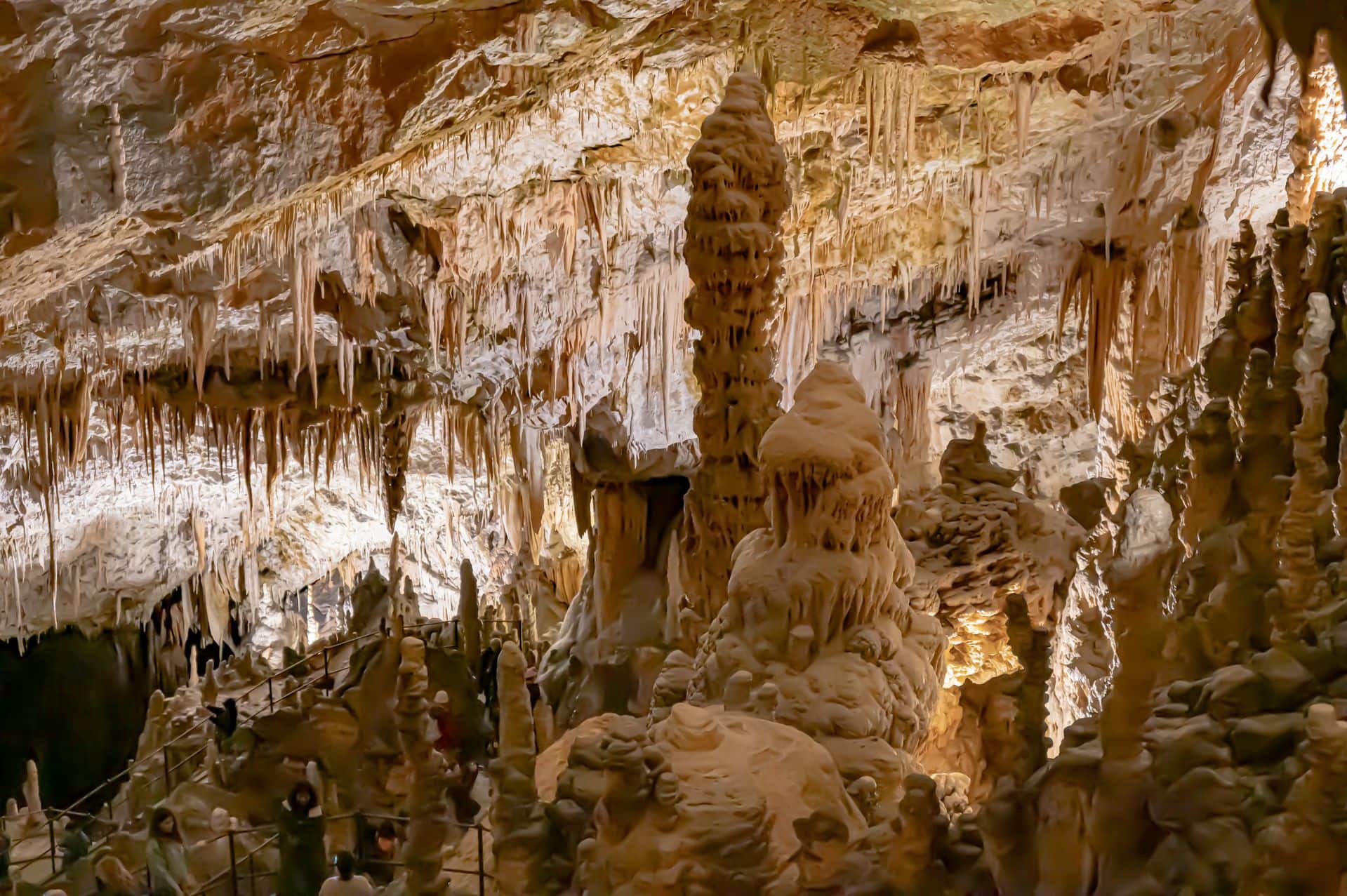
Quick answer: Postojna Cave is the cave most visitors to Slovenia see, and for once the most popular option is also the right one for a first visit — it is big, well-lit, easy to walk, and you cover the first stretch underground on a narrow-gauge train that has been running since 1872.
The cave sits in the heart of Slovenia’s karst, part of the same limestone belt covered in our guide to Slovenian caves and karst. The Pivka River still carves the lower levels today, and the route open to visitors includes some of the largest decorated chambers open to the public anywhere in Europe.
Here is what to know before you go, and how it compares to Skocjan, the other cave people ask about.
Postojna Cave at a Glance
- First discovered13th century (signatures dated 1213)
- Opened to visitors1819
- Total explored lengthAbout 24.3 km
- Open to visitorsAbout 5 km (3.7 km by train, rest on foot)
- Deepest point115 m below the entrance
- Underground railwayRunning since 1872
- Temperature insideAround 10°C year-round
- Annual visitorsSeveral hundred thousand
- Formed byThe Pivka River, over roughly 3 million years
A Short History of Postojna Cave
People knew about Postojna long before anyone thought to sell tickets. Signatures scratched into the walls date back to 1213, left by visitors who reached only the first, cramped chambers near the entrance.
Everything changed in April 1818, when Luka Cec, a local man employed to light lamps ahead of a royal visit, wandered past the point earlier visitors had reached and found the vast decorated galleries that make up today’s route — by his own account, he described it as a paradise. The cave opened for organised visits the following year, in 1819, after a visit by Archduke Ferdinand I, making it one of the earliest show caves anywhere.
In 1872, rails were laid through the horizontal passages for the world’s first railway inside a cave — at first pushed by hand, later pulled by gas and then electric locomotives. Electric lighting followed in 1884, reportedly before the streets of Ljubljana or London had it. The passages open today have grown since: an older survey put the explored system at around 20.6 km, extended through further exploration to today’s roughly 24.3 km.
What the Tour Is Actually Like
Every tour starts with a train ride: about 3.7 km on the world’s only double-track cave railway, through narrow passages that open suddenly into chambers several storeys high. From there, groups continue on foot — roughly 1.5 km along a paved, gently sloping path — with a guide in your own language for the busiest slots and shared multilingual commentary at quieter times. The whole tour runs about 90 minutes.
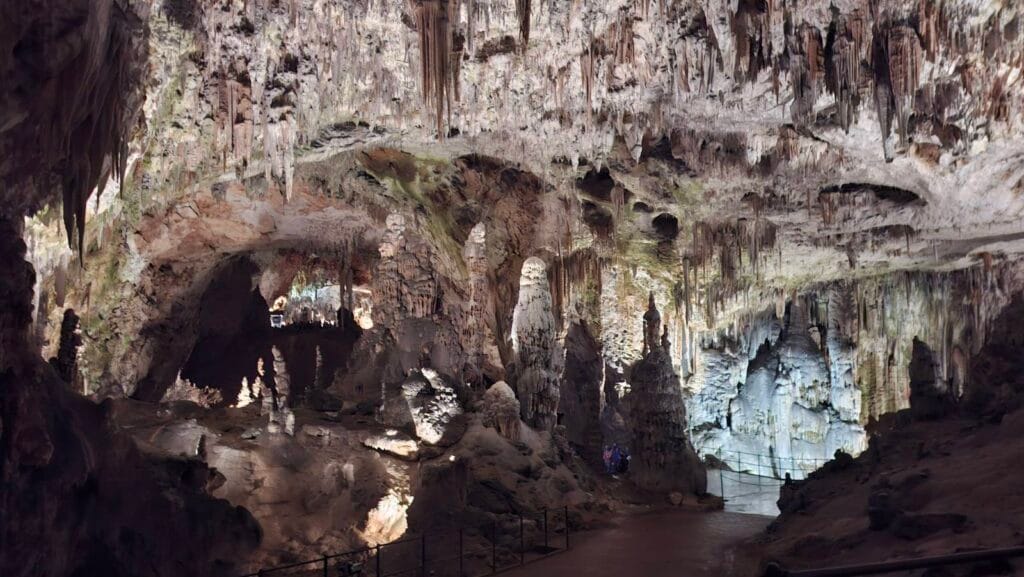
Photography is allowed throughout, unlike at Skocjan. Two things catch first-timers off guard: the temperature, a constant 10°C even in the middle of summer, and Brilliant, a five-metre pure-white stalagmite that has become the symbol of the cave. The walking section ends at a vivarium holding live olms — blind cave salamanders nicknamed “baby dragons” that can survive years without food and exist nowhere outside this karst.
When to Go
This is a Claude judgement call, not a measured fact: the cave is busiest through July and August, when the 10:00 and 12:00 departures can sell out two to three days ahead. Early-morning or 14:00/16:00 slots run noticeably quieter, and the shoulder months of May, June, September and October keep the crowds down while the weather outside is still pleasant. Winter departures are fewer — two or three a day — but the temperature inside never changes, which makes it one of the better indoor options on a cold or wet day.
Planning Your Visit
| Detail | What to expect | Notes |
|---|---|---|
| Tour length | About 90 minutes | Train plus a guided walk |
| Walking distance | About 1.5 km | Paved path, gentle grade, some steps |
| Ticket price | Roughly €28-31 adult, lower in low season | Combined tickets with Predjama Castle exist — check current prices before booking |
| Departures | Hourly in July-August, sparser off-season | Book ahead for summer midday slots |
| From Ljubljana | About 55 km, under an hour by car | Bus and train also run to Postojna town |
| Accessibility | Suitable for most visitors | Ask staff about strollers or mobility needs |
| What to bring | A jacket, closed shoes | 10°C year-round, even in August |
Partner link — booking through Tiqets supports Tips in Slovenia at no extra cost to you.
Book Postojna Cave tickets on TiqetsLook closer
Three Things to Look For
Nearby: Predjama Castle
About 9 km away, a castle built directly into a cliff face, with a cave system running behind and above it — the reason a 15th-century siege failed to starve it out.
Getting There and What Else Is Nearby
Postojna is 55 km from Ljubljana, about 45 minutes to an hour by car via the A1 motorway; the cave is a short signposted drive from the Postojna exit, and buses and trains from Ljubljana also stop in Postojna town, about 1.5 km from the entrance.
If you’re coming from the coast, Postojna sits almost exactly halfway between Ljubljana and Trieste, roughly 40 minutes from either direction. Predjama Castle is barely 9 km away — manageable as a second stop the same day. Further into the karst, Skocjan Caves and the smaller Vilenica and Krizna caves round out the region, all covered in our overview of Slovenian caves and karst.
Postojna or Skocjan?
| Cave | Route | Tour length | Walking | Highlight | Best for |
|---|---|---|---|---|---|
| Postojna Cave | Train, then a paved path | About 90 min | About 1.5 km | Vast decorated chambers, the olm | First-time visitors, families |
| Skocjan Caves | On foot only | 2-3 hours | Several km, many steps | A 150 m-deep underground river canyon; UNESCO World Heritage since 1986 | Visitors who want the more dramatic, physical route |
Postojna is the spectacle; Skocjan is the one people remember most vividly. If you only have time for one, Postojna is the easier, more reliable choice, especially with children or limited mobility. If you can manage the steps, Skocjan is the one worth the detour.
Frequently Asked Questions
How long does the Postojna Cave tour take?
About 90 minutes in total: roughly 3.7 km by train followed by about 1.5 km on foot with a guide.
How cold is it inside Postojna Cave?
A constant 10 degrees Celsius year-round, even during a hot Slovenian summer. Bring a jacket regardless of the season outside.
Is Postojna Cave suitable for children and older visitors?
Yes. The route is built to accommodate families with young children and visitors with limited mobility, though there are some steps and uneven sections — it is worth asking staff about specific needs when you book.
Do I need to book Postojna Cave tickets in advance?
It is recommended, especially in summer. The most popular midday departures can sell out two to three days ahead in July and August.
Can you see the olm at Postojna Cave?
Yes. Live olms are on display in a vivarium at the end of the walking section of the tour.
More on Slovenia’s underground: read the Lake Cerknica guide for the same karst hydrology above ground, browse every guide in Slovenian caves and karst, or start planning the wider trip at Tips in Slovenia.

Related guides
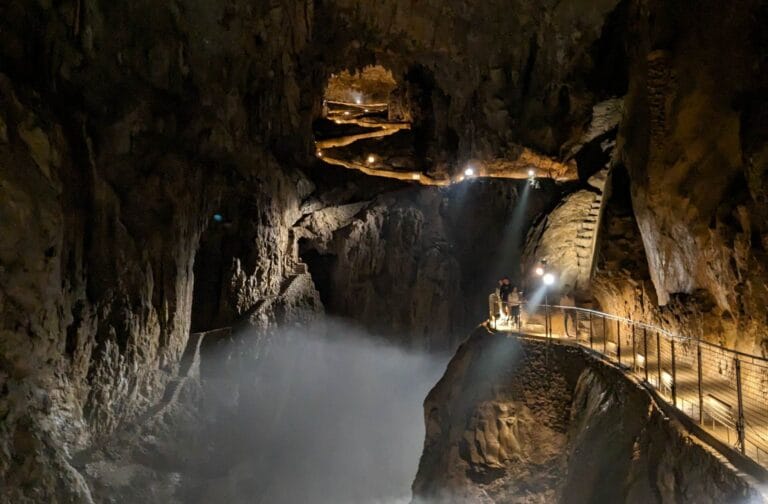 Skocjan Caves: Slovenia’s UNESCO Underground Canyon, ExplainedSlovenia's most dramatic cave: an on-foot walk through a UNESCO-listed canyon, crossing a bridge suspended 47 metres above…