Skocjan Caves: Slovenia’s UNESCO Underground Canyon, Explained
by Peter · Published Aug 31, 2026 · 6 min read
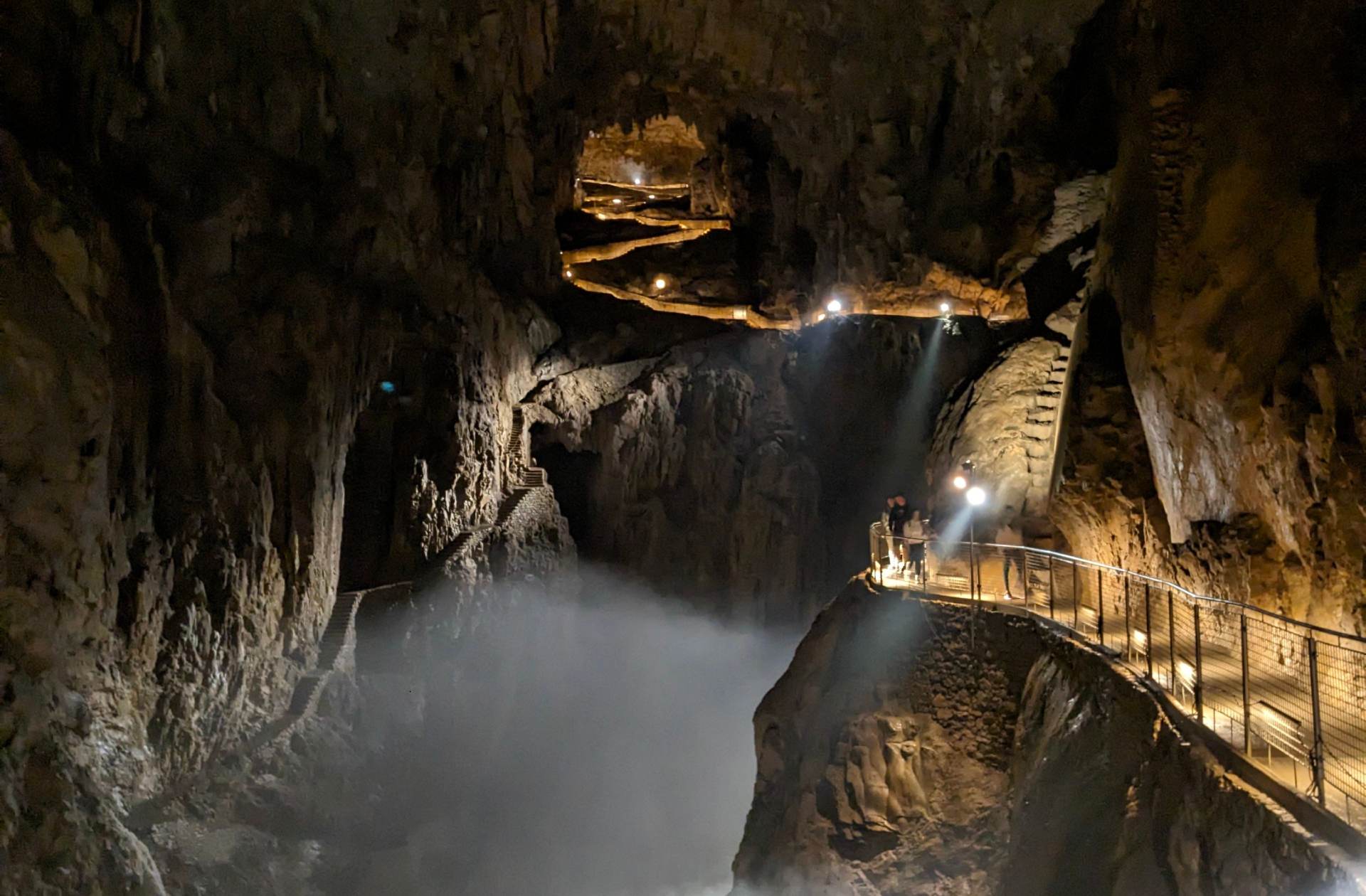
Quick answer: Skocjan Caves are Slovenia’s other essential cave, and the more physically dramatic of the two: an on-foot walk into a UNESCO World Heritage canyon carved by the Reka River, crossing a bridge suspended 47 metres above the water. There is no train and no self-paced stretch like at Postojna – just steps, a guide, and one of the largest underground chambers in Europe.
Skocjan sits in the same limestone belt covered in our guide to Slovenian caves and karst, but it earns a different kind of reputation. Where Postojna is built for volume, Skocjan is built around a single overwhelming feature: the underground canyon the Reka River has carved through the karst, a UNESCO World Heritage Site since 1986 and, according to UNESCO’s own listing, the site that gave geology the words karst and doline in the first place.
The river disappears into the ground above the cave at the Big Collapse Doline and does not resurface for another 34 km, eventually reaching the Adriatic coast in Italy. Here is what to know before you go, and how it compares to Postojna Cave, the cave most first-time visitors see instead.
Skocjan Caves at a Glance
- First recordedWritten sources from the 2nd century BC
- Opened to tourismVisitors’ book from 1819; sections opened 1933
- Total explored lengthAbout 6.2 km
- Underground canyonAbout 2 km long, up to 150 m high
- Deepest pointOver 200 m below the surface
- Temperature insideAround 10-12°C year-round
- Annual visitorsAround 100,000
- Protected statusUNESCO World Heritage since 1986; Ramsar Wetland since 1999
- Formed byThe Reka River, which sinks underground here and resurfaces 34 km away
A Short History of Skocjan Caves
The Reka River sinking into the ground at Skocjan was known in antiquity – the Greek geographer Posidonius described it in the 2nd century BC, and the site appears on maps as early as 1561. What lay beyond the entrance chambers stayed largely unmapped for another three centuries.
Systematic exploration began in 1884, when a speleological expedition started pushing past the entrance halls. Explorers reached the Dead Lake deep in the system in 1890, opening up what is now called Martel Chamber – still rated among the largest known underground chambers in Europe, with a volume of about 2.2 million cubic metres. The Silent Cave section followed in 1904, reached by climbing a sixty-metre wall.
Tourism has its own long paper trail: a visitors’ book was kept from 1 January 1819, and the first sections opened for organised visits by 1933. A serious flood in 1963 damaged the show-cave infrastructure, and the steel walkways and the Cerkvenik Bridge in use today date to a 2011 renovation. UNESCO listed the caves as a World Heritage Site in 1986, and the wider wetland was added to the Ramsar list in 1999.
What the Tour Is Actually Like
There is no train at Skocjan. Every visit is guided and on foot, roughly 3 km round trip with several hundred steps, dropping first into the Silent Cave’s dripstone halls before the path opens onto the main event: an underground river canyon that reaches around 150 metres high in places, crossed by the Cerkvenik Bridge, suspended 47 metres above the Reka. The guided programme runs close to two hours underground; allow closer to three once you count getting to and from the visitor centre.
Photography is not allowed inside the main canyon, the opposite of Postojna, where cameras are fine throughout – though it is permitted at the natural cave entrances where daylight still reaches. Two things catch first-timers off guard: the number of steps, and how loud the river gets in the canyon compared with the quiet dripstone halls at the start.
When to Go
This is a judgement call, not a measured fact: Skocjan runs on a fixed timetable rather than frequent departures, so July and August – when tours leave hourly – are also when advance booking matters most. Spring and early autumn keep the canyon just as dramatic with noticeably fewer people on the walkway. Outside the main season, from November to March, departures shrink to a couple of fixed times a day, so check the current schedule before planning a visit around it.
Planning Your Visit
| Detail | What to expect | Notes |
|---|---|---|
| Tour length | About 100 minutes underground | Guided only, no self-paced option; allow 2-3 hours in total |
| Walking distance | About 3 km | Several hundred steps; the return route climbs back out |
| Ticket price | Roughly €16-20 adult, higher in July-August | Child tickets are separate – check current prices before booking |
| Departures | Hourly June-September, a handful of fixed times off-season | Book online ahead in summer |
| From Ljubljana | About 77 km, under an hour by car | Nearest station is Divaca, a few km from the entrance |
| Accessibility | Not suited to limited mobility | Steep sections and hundreds of steps; not recommended for very young children |
| What to bring | A warm jacket, sturdy shoes | A constant 10-12°C, and the path can be slippery |
Look closer
Three Things to Look For
Nearby: Lipica Stud Farm
About 20 minutes away, the birthplace of the Lipizzaner horse breed and still a working stud farm, with tours and dressage shows running most of the year.
Getting There and What Else Is Nearby
Skocjan is about 77 km from Ljubljana, under an hour by car via the A1 motorway and a signposted turn near Divaca. Divaca itself, a few kilometres from the cave, is the nearest town and a stop on the Ljubljana-Koper railway line, so the caves are reachable without a car if you’re willing to walk or taxi the last stretch.
The coast is close from here: Koper is about 35 km away, and Piran a little further, easily combined as a single day out from either the karst or the coast – see our guide to Piran. Postojna Cave and Predjama Castle are about 35 minutes north, and Lipica Stud Farm is barely 20 minutes south.
Skocjan Caves or Postojna Cave?
| Cave | Route | Tour length | Walking | Highlight | Best for |
|---|---|---|---|---|---|
| Skocjan Caves | On foot only | 2-3 hours total | About 3 km, several hundred steps | A 150 m-deep underground river canyon; UNESCO World Heritage since 1986 | Visitors who want the more dramatic, physical route |
| Postojna Cave | Train, then a paved path | About 90 min | About 1.5 km | Vast decorated chambers, the olm | First-time visitors, families |
Skocjan is the one that stays with you; Postojna is the one that’s easier to plan around. If you have to choose, go with Postojna first if you’re short on time, travelling with young children, or short on mobility – and add Skocjan if you can manage the steps and want to see why this place lent geology its vocabulary.
Frequently Asked Questions
How long does the Skocjan Caves tour take?
The guided walk underground takes close to two hours. Plan on roughly 2-3 hours in total once you include getting to the entrance and back.
Can I take photos inside Skocjan Caves?
Not in the main underground canyon, to protect the cave environment. Photography is allowed at the natural cave entrances where daylight still reaches, and outside at the visitor centre.
Is Skocjan Caves suitable for children or visitors with limited mobility?
Not especially. The walk covers several hundred steps on a route that isn’t stroller- or wheelchair-friendly, so Postojna Cave is the easier choice for young children or anyone with mobility concerns.
Do I need to book Skocjan Caves tickets in advance?
Yes, especially from June to September, when tours run on a fixed hourly timetable and can sell out. Off-season departures are fewer, so check the schedule either way.
What is the Cerkvenik Bridge?
A steel bridge that crosses the underground canyon 47 metres above the Reka river, added during a 2011 renovation of the show-cave infrastructure – one of the most memorable moments of the walk.
More on Slovenia’s underground: browse every guide in Slovenian caves and karst, or start planning the wider trip at Tips in Slovenia.

Peter
Writes destination guides for Tips in Slovenia, covering the country's cities, hidden gems and day trips.
Related guides
 Slovenian Caves & Karst · 30 Aug 2026Postojna Cave: Slovenia’s Most-Visited Cave, ExplainedSlovenia's most-visited cave: an easy, partly-by-train tour through vast decorated chambers and the underground olm.
Newsletter
Don't miss anything new
One new Slovenia guide in your inbox every couple of weeks. No spam, unsubscribe any time.