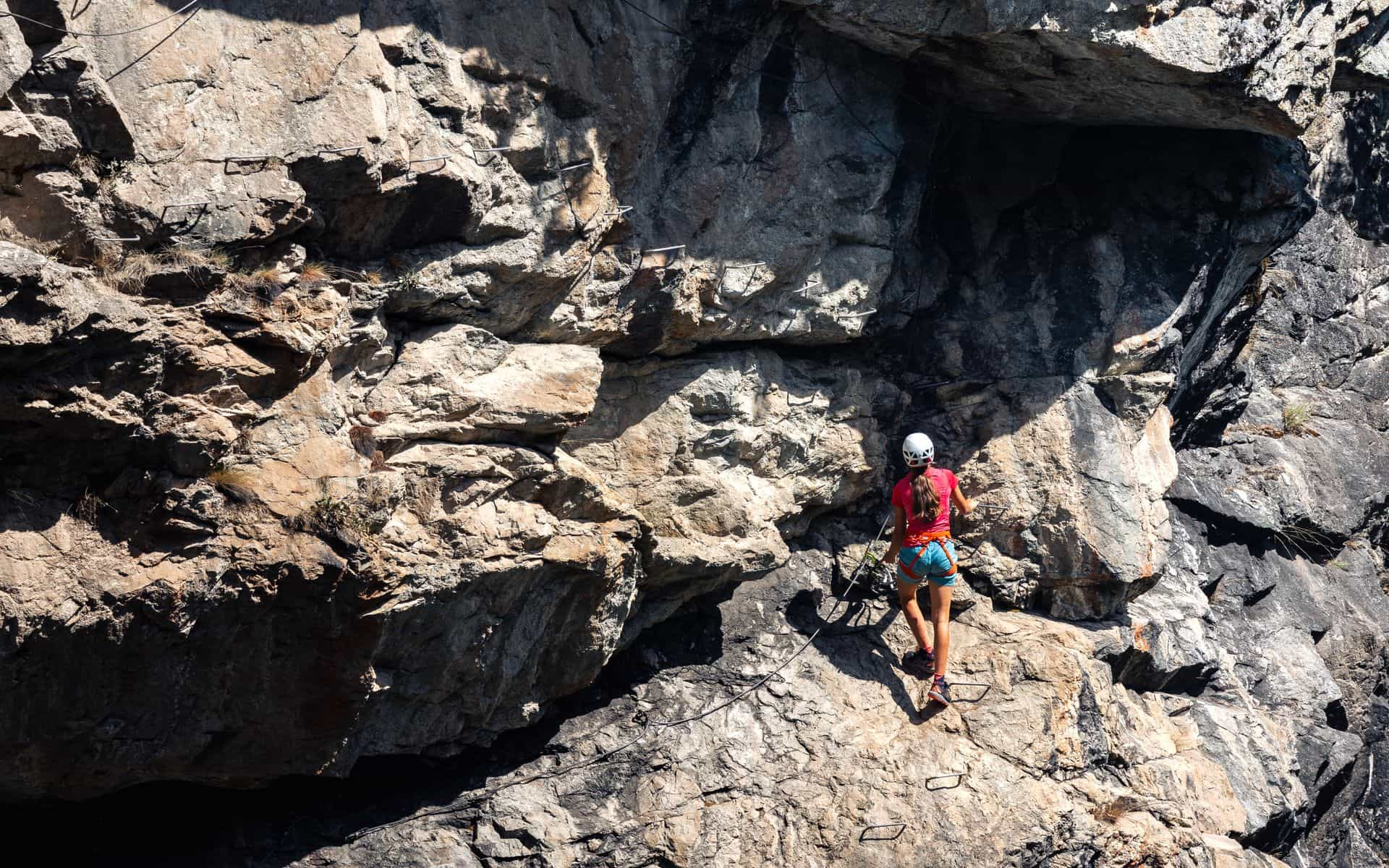
Via ferratas are protected climbing routes — fixed cables, metal rungs and pegs bolted into the rock — that let hikers climb terrain that would otherwise need real rock-climbing skills and gear. Slovenia has dozens of them scattered through the Julian Alps and Kamnik-Savinja Alps, from a genuinely easy family route near Bovec to multi-hour alpine routes that double as approaches to Triglav itself. The catch: Slovenian tourism sites often label things “via ferrata” that the Planinska zveza Slovenije (PZS, the Slovenian Alpine Association) classifies differently — so the first thing worth understanding isn’t a route at all, it’s the terminology.
This guide is a companion to our Climbing Triglav guide, since one of the standard Triglav approaches (the Prag route from Vrata Valley) is itself graded as via-ferrata terrain for its crux section, and to our Kranjska Gora travel guide, since several of the most visitor-friendly routes start a short drive from that town.
If you’re new to via ferratas entirely, treat this as the overview before you pick a specific route — what the grading actually means, which routes are realistic for a first attempt, whether you need a guide, and what tends to go wrong for people doing this for the first time in Slovenia specifically.
“Via Ferrata” or “Zavarovana Pot”? Understanding the Difference
In everyday English-language marketing, “via ferrata” gets used as a catch-all for any Slovenian mountain route with a cable on it. Slovenes draw a real distinction, and it matters for how hard a route actually feels. A true ferata is built to be climbed continuously with all four limbs, using the cable and metal rungs as the main means of progress — hands and feet on steel, not on rock. A zavarovana pot (secured or protected path) is, officially, a hiking trail where a cable is bolted on for balance and reassurance at an exposed spot, but the route is still primarily a walk — PZS grades these under the same lahka/zahtevna/zelo zahtevna (easy/demanding/very demanding) scale used on our other Slovenian Mountains guides, not under a separate ferrata grade.
The practical problem: a route marketed internationally as “the Vršič via ferrata” — Hanzova pot, on Mala Mojstrovka — is officially classified by PZS as a very demanding secured path, not a true ferrata, even though climbers commonly give it a via-ferrata letter grade too. Don’t assume the two labels always line up. When a route’s own trailhead signage, a tour operator’s marketing page and a hiking database disagree on what to call something, that’s common here, not a mistake on your part.
How Via Ferratas Are Graded
Slovenia doesn’t have its own official via-ferrata grading scale — routes here are usually marked with the imported Austrian-style letter system, A to E (sometimes extended to F), where A is the easiest and E/F means sustained, strenuous climbing that demands real upper-body strength and experience. It’s a technical-difficulty scale, not a measure of length or how tiring a route is overall, and — worth saying plainly — different guidebooks, hiking databases and tour operators don’t always agree on the letter for the same route. Treat any single grade you read, including the ones below, as a starting point to cross-check against the operator or source you’re actually relying on, not a fixed fact.
A — Easy
Mostly cable for balance, straightforward footing. A reasonable first via ferrata for a fit hiker with no climbing background.
B — Moderate
Steeper sections and more exposure, but rungs and footholds are generally obvious and well spaced.
C — Demanding
Sustained steep climbing, real arm strength needed, exposure that will unsettle anyone with a fear of heights. Guided or well-practiced only.
D/E — Hard to Extreme
Overhanging or near-vertical pitches, minimal rest, significant physical demand even for trained climbers. Not a tourist outing.
The Best Via Ferratas for Visitors
These are the routes that come up again and again as realistic options for a fit, non-expert visitor — not the full list of everything climbable in Slovenia. Grades and timings vary by source (noted where they genuinely conflict), so use this as a starting comparison, then check the specific operator or hut you’re relying on closer to your date.
| Route | Near | Grade | Climbing time | Elevation gain |
|---|---|---|---|---|
| Prestreljenik | Kanin cable car, Bovec | A | ~45 min | ~110-250m |
| Aljaževa pot | Mojstrana | A-B | ~1h | ~180-205m |
| Pot Mojstranških Veveric | Mojstrana (same trailhead) | C | ~1h | ~180-205m |
| Hvadnik | Gozd Martuljek | B-C | ~2h | ~250m |
| Hanzova pot | Vršič Pass / Mala Mojstrovka | B-C | 2-2.5h | ~720m |
| Mangart, Italian side | Mangart Saddle, Bovec | B-C | ~1-2h | ~300-450m |
| Mangart, Slovenian side | Mangart Saddle | C | ~1-2h | ~350-450m |
| Prag route (Triglav) | Vrata Valley | Crux B, overall hike T4 | ~5h to Kredarica | ~1,550-1,900m |
Prestreljenik, reached by the Kanin cable car above Bovec, is consistently described as the easiest and most family-friendly ferrata in the country — short, graded A, with the cable car doing most of the elevation work before you even start. Check the cable car’s last-descent time before you go; missing it strands you at the top station.
Aljaževa pot and Pot Mojstranških Veveric share a trailhead above Mojstrana’s mountaineering museum and cross each other repeatedly on the same hillside, which makes them a convenient pair to compare: Aljaževa pot is the gentler of the two (mostly A, a few B moves), while Veveric is a genuine step up (consistently C, with one source noting a trailhead sign claiming D that most climbers dispute). Both close seasonally, roughly November through March.
Hvadnik, above Gozd Martuljek, starts with a steep boulder scramble up a streambed before the cabled section proper — even the town of Kranjska Gora’s own tourism page describes it inconsistently (calling it both “B/C” and an “easy path” in different spots), which is a useful reminder that official listings aren’t always internally consistent either.
Hanzova pot, the route most often marketed as “the via ferrata at Vršič Pass,” is the one with the most disagreement across sources — duration estimates range from roughly 3 to over 4 hours round trip depending on your start point and pace, and multiple independent sources flag heavy exposure on narrow ledges regardless of the letter grade assigned. Snow and ice can linger into summer on the approach, which single-handedly changes the difficulty.
Mangart has two separate ferratas near its summit (2,679m) reachable from the same saddle via Slovenia’s highest paved road — the Italian-side route is consistently described as the easier of the pair, while the Slovenian side is steeper with more loose rock. Doing both in one day, as several guided tours do, is a full day out from Bled once you count the drive.
The Prag route up to Kredarica hut, covered in more depth in our Climbing Triglav guide, is really a demanding alpine hike (Swiss scale T4) with one genuine via-ferrata crux — a near-vertical pitch nicknamed Medvedova glava (“Bear’s Rock”) graded around B on its own. It’s not a route to treat as a standalone ferrata outing; it’s a full day toward the summit.
Gear: Rent or Bring Your Own
A via ferrata set is non-negotiable: a UIAA/CE-certified harness, helmet, and a shock-absorbing lanyard with two carabiners (never improvised from climbing gear not rated for this use). Several sources on independently doing Slovenian ferratas note that bringing your own kit is the more common and more convenient approach if you already own one, since rental shops cluster specifically around Bled rather than near the trailheads themselves — so factor in a detour if you’re renting and starting from somewhere like Bovec or Kranjska Gora.
More Ways to Experience Slovenia’s Via Ferratas
Partner link — booking through this widget supports Tips in Slovenia at no extra cost to you.
Guided or Independent?
This genuinely splits by route and by your own experience level, not by a blanket rule.
Independent
A/B-graded routes
- Prestreljenik, Aljaževa pot and the Italian side of Mangart are commonly done independently by fit, non-expert visitors with their own gear and basic route-finding confidence.
- Still means carrying and knowing how to use a proper via ferrata set — not simply following the cable with nothing clipped in.
- Check seasonal closures and cable car last-ride times before you commit to a route.
Guided
C-graded routes and first-timers
- A Slovenian mountain-rescue source interviewed by RTV SLO specifically flagged inexperienced climbers jumping straight to harder grades after seeing photos online as a real, recurring safety problem.
- Bled-based operators (Altitude Activities is one established example) run guided trips on routes like Hvadnik and Mangart, with gear included — useful if you don’t own a set or have never used one.
- Expect real price variation between operators for the same route — we saw a roughly €100-160 range quoted for Hvadnik alone between two operators, so it’s worth comparing before booking.
Safety on the Trail
The grade on paper isn’t the whole risk. More than one experienced climber’s account of Slovenian ferratas mentions being more unsettled by the short unprotected scrambling sections between cabled stretches than by the ferrata itself — don’t assume “easy” means there’s nothing to actually climb. Rockfall from other parties is a recurring, specifically-flagged hazard on busier routes like the Prag route and Hanzova pot, which is exactly why a helmet isn’t optional. Snow and ice can linger on north-facing or high-altitude sections well into early summer even when the valley below looks fully in season — if in doubt, ask locally (a hut, a guide operator, or the PZS) before committing to a route rather than assuming conditions match the calendar.
When to Go
Most of the lower-elevation routes near Mojstrana and Gozd Martuljek close seasonally, roughly November through March or April, and reopen once the worst of the winter ice has cleared — exact dates vary by route and year, so check before planning a shoulder-season trip. Higher routes like Hanzova pot and Mangart depend even more on conditions: both sit above 2,000m, and multiple sources mention snow persisting into what would otherwise be a normal summer hiking window. Broadly, July through September is the safest planning window for the higher routes, with June and October workable for the lower, more sheltered ones if conditions cooperate — but a local check close to your date beats any fixed calendar rule here.
Explore More Via Ferrata and Mountain Tours
Partner link — booking through this widget supports Tips in Slovenia at no extra cost to you.
Frequently Asked Questions
Do I need climbing experience to do a via ferrata in Slovenia?
Not for the easiest, A-graded routes like Prestreljenik — a reasonable level of fitness and comfort with heights matters more than prior climbing experience. You do need to know how to use a via ferrata lanyard set correctly before you start, which a rental shop or guide will show you if you’ve never used one.
What’s the difference between a via ferrata and a “secured path” in Slovenia?
A true via ferrata (ferata) is built to be climbed continuously using the cable and rungs as your main means of progress. A zavarovana pot (secured path) is officially a hiking trail with a cable added at an exposed spot for balance, graded under PZS’s regular lahka/zahtevna/zelo zahtevna hiking scale rather than a separate ferrata grade — even though some, like Hanzova pot at Vršič, get marketed as ferratas anyway.
Can I rent via ferrata gear in Slovenia?
Yes, mainly through operators based in Bled. Bringing your own set is more common if you already own one, since rental shops aren’t typically located right at the trailheads themselves — worth planning the detour if you’re starting from somewhere like Bovec or Kranjska Gora instead.
Which via ferrata in Slovenia is best for beginners?
Prestreljenik, above Bovec via the Kanin cable car, is the most consistently recommended first via ferrata — graded A, short, and with most of the elevation already handled by the cable car before you start climbing.
Do I need a guide for a via ferrata in Slovenia?
Not for the easier A/B-graded routes if you’re experienced with your own gear. For C-graded routes and above, or if this is genuinely your first time using a via ferrata set, a guide is a reasonable call — a Slovenian mountain-rescue source has specifically flagged inexperienced climbers attempting routes beyond their level as a recurring safety issue.
When is via ferrata season in Slovenia?
Roughly July through September is the most reliable window for the higher routes (Hanzova pot, Mangart), since both sit above 2,000m and can hold snow well into early summer. Lower routes near Mojstrana and Gozd Martuljek have a longer season but typically close in winter, roughly November through March or April.
Is the Vršič Pass via ferrata (Hanzova pot) hard?
Sources disagree on an exact grade, but it’s consistently described as more demanding and more exposed than the easier Mojstrana-area routes, with a round trip commonly taking 3 to over 4 hours depending on your starting point. It’s officially classified by PZS as a very demanding secured path rather than a true ferrata, which doesn’t make it easier in practice.
More to read
Fresh from Slovenia Travel Tips
Thermal Spas in Slovenia: The Best Terme for a Winter Visit
Quick answer: Slovenia’s thermal spas (terme) stay open all winter, but what’s actually usable varies a lot by…
Slovenia Travel in December: Weather, Crowds, Hiking and What to Expect
December is when Slovenia goes fully festive and genuinely cold — lift-served skiing begins at the lower resorts,…
Christmas Markets in Slovenia Beyond Ljubljana: Ptuj, Kranj, Bled, Maribor and Celje
Quick answer: Ljubljana isn’t the only Slovenian city with a festive December program. Ptuj, Kranj, Bled, Maribor and…
Planning more time in the mountains? See our full Slovenian Mountains guide, the Climbing Triglav route breakdown if the Prag route via ferrata section is part of your plan, or our Kranjska Gora travel guide for where to base yourself near Mojstrana, Gozd Martuljek and the Vršič Pass.

Related guides
 Pokljuka: Hiking, Biathlon and Cross-Country Skiing on Slovenia’s High PlateauPokljuka is a forested karst plateau in the Julian Alps, about 15 km west of Bled and part…
 Viševnik: Routes, Difficulty and Slovenia’s Easiest Two-ThousanderViševnik (2,050 m) is routinely named the most-visited peak above 2,000 m in Slovenia — not because it’s…
 Skiing in Slovenia: Resorts, Piste Lengths and 2026/27 Opening DatesSlovenia’s ski season normally runs from late November to late March, spread across eleven resorts from the high…