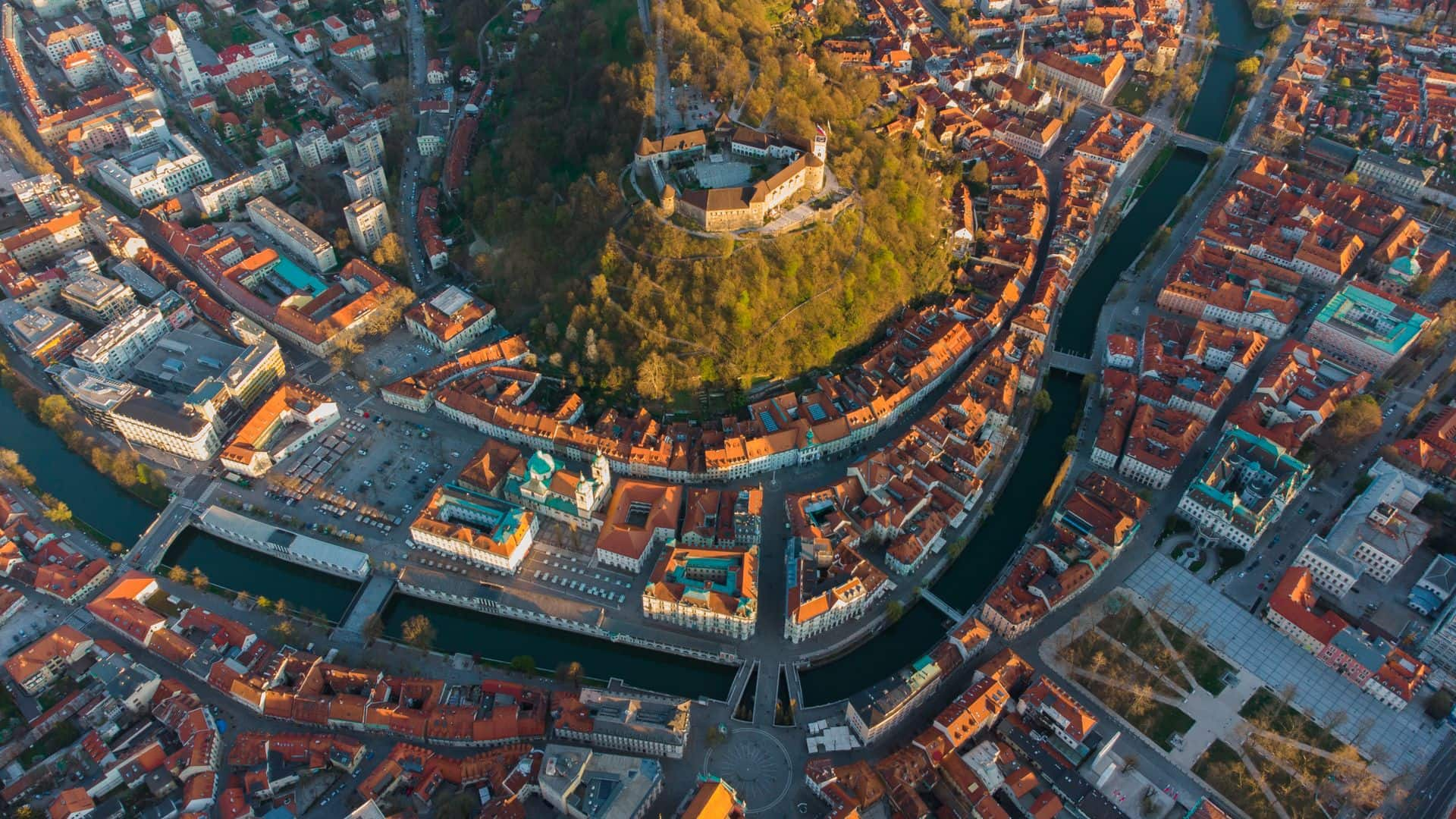
Most visitors do best with two or three bases rather than one hotel for the whole trip. Ljubljana works well for culture, food and easy transport connections; Bled or Bohinj puts you in the Julian Alps; the coast (Piran, Izola or Portorož) covers beach and old-town time. Slovenia is small enough that switching base rarely costs more than an hour or two on the road — so let your itinerary decide where you sleep, not the other way around.
This guide is part of our Slovenia Travel Tips series and sits alongside our broader accommodation coverage. It won’t recommend specific hotels — prices and availability change too fast for that to stay useful — but it will tell you which part of the country to book in, and why that choice matters more in Slovenia than in most places.
The reason it matters: Slovenia packs an unusual amount of variety into a small footprint. In the time it takes to get bored of one view, you can be looking at a completely different one — alpine lake, Adriatic harbour, karst cave, vineyard hill. That’s a gift for itinerary planning and a genuine headache for picking where to stay, because the “best” base changes completely depending on whether your week is about hiking, swimming, wine or city food. The sections below walk through each region honestly, including who it doesn’t suit.
A quick reference for the questions that come up most.
| Region | Best for |
|---|---|
| Ljubljana | First-timers, food, easy transport, no car needed |
| Bled & Bohinj | Lakes, mountain views, moderate hiking |
| The coast (Piran, Izola, Portorož) | Beach time, seafood, Venetian old towns |
| Soča Valley (Bovec, Kobarid) | Rafting, canyoning, serious hiking |
| Maribor & Štajerska | Wine country, a quieter second city |
| Mountain huts | Multi-day hikes toward Triglav and beyond |
| Bela Krajina / Kolpa | A genuinely quiet, off-route week |
Ljubljana
Ljubljana is the default first base for a reason. It’s compact enough to walk end to end in twenty minutes, sits roughly in the middle of the country, and has by far the best transport links of anywhere in Slovenia — the airport is about 24km northwest, and nearly every bus and train route in the country either starts or passes through here. If you’re not renting a car, this is the base that makes a car-free trip actually work, since Bled, Postojna Cave and several other major sights are reachable as day trips by public transport.
It’s also simply a good place to spend time on its own terms: a walkable old town along the Ljubljanica river, a hilltop castle, and a food and café scene that holds up against much bigger capitals. The trade-off is that Ljubljana itself has no lake, no sea and no real mountain scenery at its doorstep — it’s a base you travel out from, not a destination you stay inside for a week. Full details on what to actually do there are in our Ljubljana travel guide.
Bled & Bohinj
This is the Julian Alps base, and for most first-time visitors it’s the second stop after Ljubljana. Bled is the famous one — the island, the clifftop castle, the postcard view — and it books up hardest and earliest of anywhere in the country, especially around the lake itself in July and August. Lake Bohinj, about half an hour further into the mountains, is quieter, less developed and arguably more beautiful, at the cost of fewer restaurants and a shorter list of things to do after dark.
Basing here makes sense if hiking, lake swimming or Triglav National Park scenery is the point of your trip — Lake Jasna and the start of the Vršič Pass are both a manageable drive away, and multi-day treks toward Triglav itself typically begin from around here. It makes less sense as a base for the coast or for Ljubljana nightlife — both are over an hour away, and Bled in particular empties out once the day-trip crowds leave in the evening. Bohinj over Bled is usually the right call if you’d rather spend your budget on fewer, better meals than on lake-view premium pricing.
The Slovenian Coast
Slovenia’s Adriatic coastline is short — about 47km — but it packs in three towns with real character, each a different flavour of the same seaside base. Piran is the postcard choice: a car-free Venetian old town on a narrow peninsula, beautiful but small, with limited accommodation that fills up fast in summer. Izola, a short drive or bus ride along the coast, is the working fishing-harbour version — fewer tour groups, better seafood prices, a genuinely local feel. Portorož is the resort town next door, with the region’s biggest hotels, a proper beach promenade and the closest thing Slovenia has to a classic seaside holiday strip.
The three sit close enough together that basing in any one of them puts the other two within a short drive or local bus, so the choice really comes down to what kind of coastal week you want: old-town charm and no cars (Piran), a cheaper and more local base (Izola), or beach resort comfort (Portorož). The whole stretch is Slovenia’s warmest, driest corner, which makes it the natural pairing with a Ljubljana or Bled base rather than a full week on its own — most visitors give it two or three nights, not seven.
Soča Valley: Bovec and Kobarid
This is the base for people who came to Slovenia to do things, not just see them. The Soča River is the turquoise water you’ve probably seen in photos, and Bovec and Kobarid are the two small towns built around rafting, kayaking, canyoning and via ferrata that line its banks. It’s also a serious hiking base in its own right, with trailheads into the Julian Alps that see a fraction of the foot traffic around Bled.
The honest catch is getting there and back. There’s no fast year-round road from Ljubljana — the realistic options are a roughly three-to-three-and-a-half-hour drive via Idrija that works in any season, or the dramatic but seasonal route over the Vršič Pass (open roughly late May to November, weather-dependent). That distance is exactly why most itineraries treat the valley as an overnight stop rather than a day trip from Ljubljana or Bled — trying to do it as a day trip burns most of the day on the road. If adventure sports or quiet, dramatic hiking is the main reason you’re coming to Slovenia, base here for two or three nights rather than trying to squeeze it into a drive-by.
Maribor & Štajerska Wine Country
Maribor is Slovenia’s second city, and it’s a genuinely different experience from Ljubljana — bigger streets, a slower pace, and far fewer tourists per café table. It sits at the edge of Štajerska, the country’s aromatic white-wine region, which makes it the natural base for anyone whose trip is built around vineyards rather than mountains or beaches — rolling wine hills, small family wineries and tasting rooms are a short drive out of town in almost every direction.
It’s a weaker choice if your priority is postcard mountain or lake scenery, since Maribor itself is a flatter, more urban setting than Bled or Bohinj, and it sits further from the coast than Ljubljana does. But for wine-focused travel, or simply for seeing a less tourist-saturated side of the country, it’s worth at least a night or two — paired well with a side trip to Goriška Brda if you have a car and want to compare Slovenia’s two very different wine regions in one trip.
Mountain Huts
If your plan involves more than a single day on a mountain — most routes up Triglav, a multi-day loop through the Soča-side peaks, or the Triglav Lakes Valley — a mountain hut (koča) is a different kind of base entirely, and it needs different planning. Huts run by the Slovenian Alpine Association (PZS) offer dorm-style beds, basic hot meals and, in the busiest ones, surprisingly good food for how remote they are.
Two things catch newcomers out. First, booking a bed in advance is genuinely necessary in July and August — the popular huts on the main Triglav routes fill up, and turning up without a reservation can mean no bed at all. Second, bring cash: while online bookings need a card, huts themselves run almost entirely on cash for food, drinks and settling your stay once you’re there, as covered in our cash in Slovenia guide. This isn’t a base for comfort — it’s a base for being somewhere no road reaches, which for a certain kind of trip is exactly the point.
Bela Krajina and the Kolpa River
This is the option almost nobody books, which is precisely its appeal. Tucked into Slovenia’s far south-east corner along the Croatian border, the Kolpa River is the country’s warmest swimming water and runs through a string of villages that see a fraction of the visitors Bled or the coast do. Riverside campsites outnumber hotels here, which suits the region’s whole character — this is a slow, unhurried base, not a sightseeing-checklist one.
It doesn’t work as a base if you’re trying to cover a lot of the country in a short trip — it’s genuinely out of the way, with longer drives to everywhere else on this list than any other region here. But for a dedicated few days of swimming, canoeing and doing very little else, paired with nowhere else on the itinerary, it’s one of the few places left in Slovenia that still feels undiscovered.
You rarely need more than two or three bases
Slovenia’s small size tempts people into over-planning — a new hotel every single night, chasing every region on this list in one trip. In practice, most of the country is within a two-to-three-hour drive of Ljubljana, so a trip built around two or three bases (say, Ljubljana, then Bled, then the coast) with day trips from each usually beats a different bed every night. Fewer check-ins means more actual time doing things, not packing.
Types of Accommodation
Slovenia’s accommodation mix is fairly standard for Central Europe, with a few local quirks worth knowing before you book. Hotels cluster in the bigger towns and resort areas (Ljubljana, Bled, Portorož); as a rough guide, and at the time of writing, expect few under about €50 a night in peak season, with comfortable mid-range rooms more typically around €75-100. Private apartments and rooms, widely available through the usual booking platforms, tend to run cheaper — roughly €60 for a one-bedroom in Ljubljana, somewhat less in smaller towns like Maribor or Ptuj. Hostels exist mainly in Ljubljana and Bled, with dorm beds commonly in the €15-20 range.
Camping and glamping are a genuinely good option here, not a budget fallback — Slovenia’s camping standards are high, and riverside or lakeside sites (the Kolpa and Soča valleys especially) are often a nicer setting than a comparably priced hotel room. For a closer look at glamping specifically — the types available and which regions do it best — see our full guide to camping and glamping in Slovenia. Rural guesthouses (gostišča) are common outside the main tourist towns and usually include home-cooked meals, a good option if Maribor/Štajerska or Bela Krajina is on your route.
One practical detail that catches visitors off guard: Slovenia charges a nightly tourist tax (turistična taksa) on top of the room rate, set independently by each municipality up to a legal cap of around €2.50 plus a 25% promotional surcharge — in practice this lands somewhere around €2 to just over €3 per person, per night, with busier destinations like Ljubljana typically near the top of that range and smaller towns lower. It’s usually collected at check-in or added to the final bill rather than shown in the headline room price, so don’t be surprised if the total runs a few euros higher than what you booked.
A side-by-side comparison of everything above.
| Region | Best for | Days worth basing | Price level | Nearest hub |
|---|---|---|---|---|
| Ljubljana | First-timers, no car, food | 2-3 | Mid-to-high | Capital, central |
| Bled & Bohinj | Lakes, moderate hiking | 2-3 | High (Bled) / mid (Bohinj) | ~45-60 min from Ljubljana |
| The coast | Beach, old towns, seafood | 2-3 | Mid-to-high in summer | ~1h15-1h30 from Ljubljana |
| Soča Valley | Rafting, canyoning, hiking | 2-3 | Mid | ~3-3.5h from Ljubljana |
| Maribor & Štajerska | Wine, a quieter city | 1-2 | Low-to-mid | ~1h30 from Ljubljana |
| Mountain huts | Multi-day alpine routes | 1 night per hut | Low (cash-based) | Trailhead-dependent |
| Bela Krajina / Kolpa | Quiet, swimming, camping | 2-4 | Low | ~1.5-2h from Ljubljana |
And if you’re still deciding between committing to one base or splitting your trip, here’s the honest trade-off.
One base for the whole trip
Best for: short trips, no car, minimal planning- Less packing and unpacking, no lost time checking in and out.
- Works well from Ljubljana if you’re under a week and relying on public transport.
- Caps how far you can comfortably day-trip — the coast or Soča Valley become long, tiring days from a single central base.
Two or three bases
Best for: trips over 5-6 days, drivers, first-timers wanting variety- Lets you actually wake up by the lake, the sea or the mountains instead of driving to them each day.
- More realistic for covering the Alps, the coast and Ljubljana properly in one trip.
- Needs a car for most combinations, and costs you a half-day of travel each time you switch.
Partner link — booking through this link supports Tips in Slovenia at no extra cost to you.
Compare rental car prices for SloveniaWhere is the best place to stay in Slovenia for first-time visitors?
Ljubljana, for most people. It’s central, well connected by public transport, and puts Bled and several other major sights within day-trip range if you don’t want to rent a car.
Should I stay in Ljubljana or Bled?
Both if your trip is longer than about four days. Ljubljana suits city time, food and transport links; Bled suits lake and mountain scenery. On a shorter trip, Ljubljana is the safer single base since it keeps Bled reachable as a day trip.
How many different places should I stay in Slovenia?
Two or three bases is the sweet spot for most trips over five or six days — enough to properly experience a couple of regions without losing time to constant check-ins and drives. Shorter trips usually work better from a single base.
Is it cheaper to stay in Ljubljana or a smaller town?
Smaller towns, generally. Maribor and Ptuj in particular run noticeably cheaper than Ljubljana or Bled for comparable apartments and rooms, especially outside peak summer months.
Do I need to book accommodation in Slovenia in advance?
For Bled especially, yes — it books up earliest and hardest of anywhere in the country in July and August. Mountain huts on popular Triglav routes also need advance booking in peak summer. Elsewhere, demand is less extreme, but booking a few weeks ahead in summer is still sensible.
What is the tourist tax in Slovenia?
A small nightly charge per person, set by each municipality up to a legal cap of around €2.50 plus a 25% promotional surcharge. In practice this lands somewhere around €2 to just over €3 per person per night depending on where you’re staying, usually collected at check-in or added to your final bill.
Is camping or glamping a good option in Slovenia?
Yes — standards are high, and riverside or lakeside sites, particularly along the Kolpa and Soča valleys, are often a more scenic setting than a comparably priced hotel room. It’s a genuine option rather than just a budget fallback.
More to read
Fresh from Slovenia Travel Tips
Thermal Spas in Slovenia: The Best Terme for a Winter Visit
Quick answer: Slovenia’s thermal spas (terme) stay open all winter, but what’s actually usable varies a lot by…
Slovenia Travel in December: Weather, Crowds, Hiking and What to Expect
December is when Slovenia goes fully festive and genuinely cold — lift-served skiing begins at the lower resorts,…
Christmas Markets in Slovenia Beyond Ljubljana: Ptuj, Kranj, Bled, Maribor and Celje
Quick answer: Ljubljana isn’t the only Slovenian city with a festive December program. Ptuj, Kranj, Bled, Maribor and…
More from Slovenia Travel Tips · Accommodation · Slovenian Cities · Slovenian Coast · Slovenian Mountains · Tips in Slovenia

Related guides
Thermal Spas in Slovenia: The Best Terme for a Winter VisitQuick answer: Slovenia’s thermal spas (terme) stay open all winter, but what’s actually usable varies a lot by…Slovenia Travel in December: Weather, Crowds, Hiking and What to ExpectDecember is when Slovenia goes fully festive and genuinely cold — lift-served skiing begins at the lower resorts,…Christmas Markets in Slovenia Beyond Ljubljana: Ptuj, Kranj, Bled, Maribor and CeljeQuick answer: Ljubljana isn’t the only Slovenian city with a festive December program. Ptuj, Kranj, Bled, Maribor and…